
Tapinoma
Förster, 1850
Species Guides
4- Tapinoma litorale(Odorous Tropical Twig Ant)
- Tapinoma melanocephalum(Ghost ant)
- Tapinoma schreiberi
- Tapinoma sessile(odorous house ant)
Tapinoma is a moderately diverse of ants in the Dolichoderinae, comprising approximately 87 described (81 extant, 6 fossil) with a crown age estimated at 34–49 million years. Species occur worldwide in tropical and temperate regions, exhibiting generalized foraging and flexible nesting habits. Several species, including T. sessile and T. melanocephalum, are notable as household pests and associated with human disturbance.
Pronunciation
How to pronounce Tapinoma: /tæpɪˈnoʊmə/
These audio files are automatically generated. While they are not always 100% accurate, they are a good starting point.
Identification
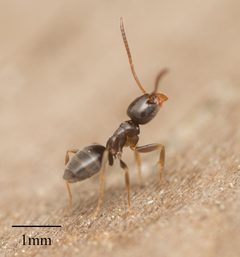
Small to medium-sized ants with . Members of the typically possess a single petiolar node and lack a sting, instead relying on chemical defenses. The T. melanocephalum group includes minute species with distinctive bicolored coloration (dark and , pale mesosoma and legs), though pigmentation characters require careful evaluation due to intraspecific variability. Species-level identification often requires morphometric analysis and examination of male genitalia.
Images
Habitat
Nesting occurs in diverse substrates: under stones, fallen logs, and bark; in plant cavities, insect galls, and refuse piles; within soil in grasslands, open fields, and woodlands. Some regularly colonize human structures including wall voids and electrical appliances. Forest-dwelling of T. sessile typically inhabit single nests, while urban populations exhibit polydomy (multiple interconnected nests).
Distribution
distribution spanning tropical and temperate regions worldwide. Native ranges include North American forests (T. sessile) and Old World tropics (T. melanocephalum); human-mediated has established across subtropical and tropical regions, with indoor records extending to heated buildings in temperate zones including Canada and Finland.
Seasonality
Activity patterns temperature-dependent; foraging resumes with spring warming following winter . In temperate regions, reproductive emerge in spring and early summer, often attracted to light sources during evening swarming . Indoor may remain active year-round.
Diet
Generalized foragers consuming sugars, proteins, and fats. obtain primarily through tending honeydew-producing hemipterans (aphids, scale insects, , treehoppers) and collecting floral nectar; protein sources include small insects and scavenged animal matter. Indoors, attracted to sugary foods, syrups, pet food, and kitchen scraps.
Host Associations
- Aphidoidea - tend colonies for honeydew; provide protection from and in exchange
- Coccoidea - scale insects tended on plants; ants maintain hygiene by removing excess honeydew
- Membracidae - treehoppers stroked with to elicit honeydew droplets
Life Cycle
Complete with , larva, pupa, and stages. Colonies founded by mated queens following . Social structure varies by : forest colonies typically monogynous (single ) and monodomous, while urban of some exhibit extreme (multiple queens) and polydomy (multiple nests), achieving unicoloniality only in urbanized areas. Reproductive produced seasonally.
Behavior
establish persistent trails between nest and food sources, enabling rapid recruitment to resources. Foraging activity increases substantially with temperature. Winged reproductives exhibit positive , often entering structures through small openings around windows and doors. Some demonstrate opportunistic nest relocation and .
Ecological Role
Ecologically significant as and scavengers; mutualistic relationships with honeydew-producing insects influence plant-herbivore dynamics and outcomes. Urban-adapted may disrupt native ; T. sessile displaced by Argentine ant (Linepithema humile) in some regions.
Human Relevance
Several are economically important household pests, particularly T. sessile (odorous house ) and T. melanocephalum (ghost ant). Indoor triggered by food residues; control typically employs slow-acting baits carried to colony. T. melanocephalum considered significant agricultural pest in greenhouses where it protects honeydew-producers from agents; also recorded in hospitals with potential for transport. Some individuals experience minor skin irritation from contact.
Similar Taxa
- Linepithema humilesimilar size and ; Argentine ant displaces T. sessile in competitive interactions; distinguished by different petiole structure and lack of characteristic coconut-like odor when crushed
- Camponotus spp.both may enter structures; carpenter ants substantially larger, polymorphic, with distinctive -shaped and potential for structural wood damage; winged reproductives of Camponotus often mistaken for pest
Sources and further reading
- BugGuide
- Wikipedia
- GBIF taxonomy match
- iNaturalist taxon
- NCBI Taxonomy
- Catalogue of Life
- Got an Ant Question? | Bug Squad
- Just Buggin' Ya! The Good, The Bad and the Bugly | Bug Squad
- Some move out, others move in - Odorous house ants, Tapinoma sessile — Bug of the Week
- Turing back the invasion – Odorous house ants, Tapinoma sessile (MISSING VIDEOS) — Bug of the Week
- A holiday brunch with my ants. Odorous house ant, Tapinoma sessile — Bug of the Week
- Ant bodyguards here and there: Odorous house ants, Tapinoma sessile, and carpenter ants, Camponotus — Bug of the Week
- Tapinoma melanocephalum (ghost ant)
- Tapinoma melanocephalum (ghost ant)
- Tapinoma melanocephalum (ghost ant).
- The previous concept of the cosmopolitan pest ant Tapinoma melanocephalum (Fabricius, 1793) includes two species (Hymenoptera: Formicidae: Tapinoma)
- Ghost Ant, Tapinoma melanocephalum (Fabricius) (Insecta: Hymenoptera: Formicidae)
- Molecular identification of the ghost ant,Tapinoma melanocephalum(Fabricius): A preliminary study
- Figure 7 from: Abdel-Dayem MM, Al Dhafer HM, Aldawood AS, Sharaf MR (2021) An update to the taxonomy and distribution of the Arabian Tapinoma Foerster, 1850 (Hymenoptera: Formicidae) with an illustrated key and remarks on habitats. Biodiversity Data Journal 9: e66058. https://doi.org/10.3897/BDJ.9.e66058
- Chemotaxonomy of Tapinoma and some Dolichoderinae ants from Europe and North Africa
- A phylogenomic overview of the ant genus Tapinoma Foerster, 1850 (Formicidae: Dolichoderinae), with the phylogeographic history of the ghost ant Tapinoma melanocephalum
- Figure 3c from: Abdel-Dayem MM, Al Dhafer HM, Aldawood AS, Sharaf MR (2021) An update to the taxonomy and distribution of the Arabian Tapinoma Foerster, 1850 (Hymenoptera: Formicidae) with an illustrated key and remarks on habitats. Biodiversity Data Journal 9: e66058. https://doi.org/10.3897/BDJ.9.e66058
- Figure 2a from: Abdel-Dayem MM, Al Dhafer HM, Aldawood AS, Sharaf MR (2021) An update to the taxonomy and distribution of the Arabian Tapinoma Foerster, 1850 (Hymenoptera: Formicidae) with an illustrated key and remarks on habitats. Biodiversity Data Journal 9: e66058. https://doi.org/10.3897/BDJ.9.e66058
- Taxonomic identity of the ghost ant, Tapinoma melanocephalum (Fabricius, 1793) (Formicidae: Dolichoderinae)
- Consistent signatures of urban adaptation in a native, urban invader ant Tapinoma sessile
- Figure 6 from: Abdel-Dayem MM, Al Dhafer HM, Aldawood AS, Sharaf MR (2021) An update to the taxonomy and distribution of the Arabian Tapinoma Foerster, 1850 (Hymenoptera: Formicidae) with an illustrated key and remarks on habitats. Biodiversity Data Journal 9: e66058. https://doi.org/10.3897/BDJ.9.e66058
- Figure 4b from: Abdel-Dayem MM, Al Dhafer HM, Aldawood AS, Sharaf MR (2021) An update to the taxonomy and distribution of the Arabian Tapinoma Foerster, 1850 (Hymenoptera: Formicidae) with an illustrated key and remarks on habitats. Biodiversity Data Journal 9: e66058. https://doi.org/10.3897/BDJ.9.e66058