
Psilidae
rust flies
Genus Guides
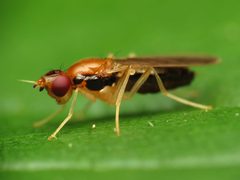
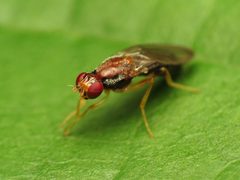
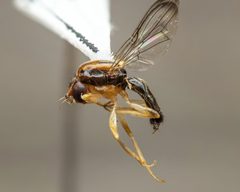
3is a of small to medium-sized flies commonly called rust flies, with at least 38 in four . The family is well represented in temperate zones and is found mainly in the Holarctic region. The carrot fly (Chamaepsila rosae) is the most economically significant member, a major agricultural pest of carrots and related crops. Larvae are phytophagous, feeding in stems, tubers, or roots of nonwoody plants.
Pronunciation
How to pronounce Psilidae: /ˈsaɪlɪˌdiː/
These audio files are automatically generated. While they are not always 100% accurate, they are a good starting point.
Identification
Distinguished from similar acalyptrate Diptera by the combination of: interrupted near R1 with only basal subcosta developed; cup closed by BM-Cu; wing with transverse weakening in basal half; tibiae without preapical bristle; vibrissae absent; third antennal segment elongated. The wing venation pattern is particularly diagnostic. Chamaepsila associated with Apiaceae crops are recognized by their economic damage to roots.
Images
Appearance
Small to medium-sized flies, 1.5–10 mm in length, with slender bodies. Coloration ranges from yellow to reddish, brown, or black. is spherical with relatively small ; often slanted backward. small with third segment conspicuously elongated; has short or long . Postvertical bristles divergent or absent. Ocelli and ocellar bristles present; vibrissae always absent. Up to two pairs of frontal bristles and scattered interfrontal setulae. Wing venation distinctive: interrupted at some distance from R1, only basal part of subcosta developed, bordering anal straight on outer side, crossvein BM-Cu present with cell cup closed. Wing usually clear to slightly tinged, sometimes with dark bands along costa, wing tip, or crossveins; wing has transverse weakening in basal half. Tibiae lack preapical bristle.
Habitat
Primarily cool temperate environments with low- vegetation. Larvae inhabit stems, tubers, or roots of nonwoody plants; a few live under tree bark. Some species form galls. associated with flowering plants for mating and oviposition.
Distribution
Mainly Holarctic: Western Palaearctic (including Russia, Turkey), Nearctic, and Japan. Recorded from Canada (Newfoundland, Quebec, Ontario, British Columbia), temperate Europe, New Zealand, Czech Republic, Slovakia, Austria, France, China, and western Washington USA. First recorded in Canada in 1885.
Seasonality
activity varies by and region. Chamaepsila rosae: first hatches mid to late April, peaks in May, with timing dependent on temperature. Seasonal occurrence documented in Québec and western Washington with geographic variation in .
Diet
Larvae are phytophagous, feeding almost exclusively on nonwoody plants. Specific include: Daucus carota (carrot, Apiaceae) for Psila rosae; Gastrodia elata and Calanthe nipponica (Orchidaceae) for Chyliza vittata; Psilolmedia oxophylaria (Moraceae) for gall-forming . : feeding habits not documented.
Host Associations
- Daucus carota - larval carrot; major agricultural pest
- Gastrodia elata - larval leafless orchid; buds and stems
- Calanthe nipponica - larval autotrophic orchid; Japanese
- Psilolmedia oxophylaria - larval gall formation on young leaves
Life Cycle
Holometabolous. stage varies: primarily as pupae in soil near plants; during mild winters also as larvae in host plant roots or harvest residues. occurs in soil. Multiple per year reported for pest in temperate regions.
Behavior
mate-seeking occurs on flowering plants attractive to -laden females. Males occasionally aggressive toward other males. Females use ovipositor to lay eggs on flowers, floral buds, bracts, or into flowers. Vegetation elements presumably important for adult orientation and protection against dehydration. Larvae tunnel into host plant roots or stems, reducing yield and marketability.
Ecological Role
Phytophagous herbivores; some form galls. Agricultural pests causing economic damage to root and stem crops. Limited parasitization or observed (7% in one gall-forming species study). Role in natural as decomposers or nutrient cyclers not documented.
Human Relevance
Several are significant agricultural and horticultural pests. Chamaepsila rosae (carrot fly) is a major pest of carrots, reducing yield and marketability through larval root tunneling. Psila nigricornis also noted as pest. Management requires monitoring seasonal activity and geographic distribution for integrated pest control.
Similar Taxa
- ScathophagidaeFormerly confused with ; Chyliza vittata was misassigned to Scathophagidae as Orchidophaga gastrodiacola before synonymy was established. Distinguished by wing venation and larval .
- Other Acalyptratae families distinguished by interrupted , closed cup, wing weakening, and absence of vibrissae.
More Details
Taxonomic notes
contains at least 38 in four per Wikipedia, though other sources list up to 12 genera including Belobackenbardia, Chamaepsila, Chyliza, Loxocera, Loxocerosoma, Oxypsila, Phytopsila, Psila, Psilosoma, Schizostomyia, Synaphopsila, and Tropeopsila. Chamaepsila tenebrica is a new addition to West Palaearctic fauna. Chyliza vittata is transpalaearctic with European and Japanese showing different associations.
Research gaps
fly and to current crop plots poorly understood. Full larval data for many requires literature review beyond available abstracts. Identification keys for Palaearctic species need revision.
Sources and further reading
- BugGuide
- Wikipedia
- GBIF taxonomy match
- iNaturalist taxon
- NCBI Taxonomy
- Catalogue of Life
- The damage the Family Psilidae to agriculture (Insecta: Diptera)
- Distribution and seasonal activity of adult carrot rust flies (Diptera: Psilidae)
- Les Psilidae de France (Diptera : Acalyptrata) : checklist et clés de détermination des genres et des espèces
- Orchidophaga gastrodiacola Kato, 2006, is Chyliza vittata Meigen, 1826 (Diptera: Psilidae): discussion on its taxonomy and biology
- Seasonal Occurrence and Geographical Distribution of the Carrot Rust Fly (Diptera: Psilidae) in Québec
- Host plant use and possibly defensive horns in <i>Trichochermes magna</i>(Psilidae: Homoptera)
- Seasonal Activity and Geographical Distribution of the Carrot Rust Fly (Diptera: Psilidae) in Western Washington1
- New records of Psilidae, Piophilidae, Lauxaniidae, Cremifaniidae and Sphaeroceridae (Diptera) from the Czech Republic and Slovakia
- Mate‐seeking and oviposition behavior of Chyliza vittata (Diptera: Psilidae) infesting the leafless orchid Gastrodia elata
- The Autotrophic OrchidCalanthe nipponicais a Potential Host Plant of Japanese Populations of the Two-Winged Fly,Chyliza vittata(Diptera: Psilidae)
- A review of the subgenus Loxocera Meigen, 1803 (Diptera, Brachycera, Psilidae) in China.