
Psila rosae
Fabricius, 1794
carrot fly, carrot rust fly
Psila rosae, commonly known as the carrot fly or carrot , is a dipteran pest of cultivated umbelliferous crops. orient to plants using volatile chemical cues from carrot foliage, with strong electroantennogram responses to propenylbenzenes such as trans-asarone and trans-methylisoeugenol. Larvae feed on carrot roots, causing characteristic mining damage that reduces crop quality and yield. The has a broad geographic distribution spanning Europe, Asia, North America, and New Zealand. occurs as both larvae and pupae, with temperature-dependent in pupae contributing to synchronization and the potential for multiple per year.
Pronunciation
How to pronounce Psila rosae: /ˈsaɪ.lə ˈrəʊ.ziː/
These audio files are automatically generated. While they are not always 100% accurate, they are a good starting point.
Identification
can be distinguished from similar psilid flies by the combination of black body coloration with yellow markings, wing venation patterns, and association with umbelliferous plants. Larval identification requires examination of and cephalopharyngeal skeleton; P. rosae larvae have two spiracles on a single posterior spiracular plate. The is reliably distinguished from the related P. nigricornis by genitalia examination in males. Damage on carrot roots—shallow, irregular mines near the root surface—are characteristic but not exclusive to this species.
Images
Appearance
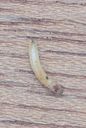
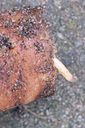
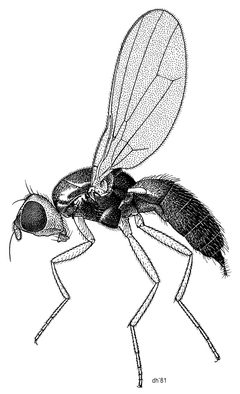
are small flies, approximately 4–5 mm in length, with a slender body and long legs typical of Psilidae. The body is predominantly black with yellowish markings on the and . Wings are clear with characteristic venation. Larvae are creamy-white, legless maggots with a tapered end and two ; third instar larvae reach approximately 8–10 mm in length. Pupae are brown, barrel-shaped, and found in soil.
Habitat
Agricultural and horticultural environments where plants are cultivated. are found in crop fields and surrounding vegetation. Larvae occur in soil around host plant roots, with third instar larvae found at depths of approximately 8 cm in uniform soil conditions, though moisture gradients can alter vertical distribution. Pre-pupal larvae show increasing avoidance of dry soil conditions, preferring moistures above 40% field capacity.
Distribution
Native to Europe; introduced to North America, New Zealand, and other regions. Present across much of Europe including the UK, Scandinavia, central and southern Europe. In North America, established in Canada (Alberta, British Columbia, New Brunswick, Newfoundland, Nova Scotia, Ontario, Prince Edward Island, Quebec) and the northern United States (California, Connecticut, Maine, Massachusetts, Michigan, New Hampshire, New York, Ohio, Oregon, Pennsylvania, Washington). Also recorded in Asia (Mongolia, parts of Russia including Amur region, Khabarovsk, Primorsk, Sakhalin, Ukraine) and New Zealand.
Seasonality
Multiple per year in favorable climates, typically two generations in temperate regions with a potential third generation in late autumn when conditions permit. from is synchronized by temperature-dependent developmental cues. Overwintering occurs as larvae or pupae; pupae formed in October–November at soil temperatures of 10–16°C enter , while larvae continue feeding and pupate in early spring at 2–8°C without diapause. Adult activity coincides with plant availability.
Diet
Larvae feed on roots of plants, mining cortical tissues and creating shallow, irregular galleries that render roots unmarketable. Larvae show behavioral responses to root volatiles, with preference for specific compounds including bornyl acetate, 2,4-dimethyl styrene, α-ionone, and β-ionone, which are minor constituents of carrot root extracts. Avoidance of trans-2-nonenal, a potential defense compound, has been demonstrated.
Host Associations
- Daucus carota - primary carrot; confirmed for oviposition and larval development
- Pastinaca sativa - parsnip
- Apium graveolens - celery
- Conium maculatum - poison hemlock
Life Cycle
Holometabolous development with , three larval instars, pupa, and stages. Eggs are laid in soil near plant roots. Larvae feed on roots for several weeks; third instar larvae are the stage in part of the . occurs in soil. Adults emerge and mate; females oviposit in response to host plant volatiles. time varies with temperature; partial third generation possible in autumn under favorable conditions. in pupae is induced by temperatures of 10–16°C during the prepupal stage, with sensitivity to diapause-inducing conditions decreasing from November to March.
Behavior
exhibit anemotactic upwind toward plant odor sources. Oviposition is mediated by foliar volatiles, with strong attraction to propenylbenzenes (trans-asarone, trans-methylisoeugenol) and leaf aldehydes (hexanal, (E)-2-hexenal, heptanal). Synergistic responses occur: trans-asarone combined with hexanal is more attractive than single compounds. Close-range oviposition site selection involves leaf surface components in addition to volatile cues. Larvae are photonegative, prefer temperatures around 15°C, and avoid temperatures above 30–40°C which become lethal above 40°C. Larvae prefer humid conditions (70–100% r.h.) and moist soil, with depth distribution influenced by soil moisture gradients. Larval orientation to roots involves klinotaxis and klinokinesis in response to specific volatile compounds.
Ecological Role
Herbivore and agricultural pest. Serves as for including Dacnusa gracilis, Loxotropa tritoma, and Aleochara sparsa. L. tritoma can act as hyperparasitoid of D. gracilis. A member of Kleidotoma also parasitizes P. rosae but appears rare. The fungus Entomophthora muscae can infect , inducing abnormal -laying . In natural , likely contributes to of wild umbellifers, though its ecological role in native European is poorly documented compared to its agricultural impact.
Human Relevance
Major economic pest of carrot, parsnip, and celery in temperate agriculture. Larval root mining reduces crop quality and marketability; damage is often concentrated near root tips in summer and more evenly distributed in autumn. Control measures include crop , physical barriers (fleece, screens), cultivars, and application. with onion or application of onion extracts reduces oviposition through repellent and diversionary effects. Understanding of volatile-mediated finding has informed development of monitoring traps and potential behavioral manipulation strategies. The is a model organism for studying insect-plant chemical and host finding .
Similar Taxa
- Psila nigricorniscongeneric also associated with umbellifers; distinguished by male genitalia and subtle morphological differences in and coloration
- Delia radicumcabbage root fly; similar size and habit but attacks Brassicaceae rather than Apiaceae, distinguished by association and
More Details
Chemical ecology and host finding
Research on P. rosae has significantly advanced understanding of insect olfaction and -plant location. The detects host plants at extremely low concentrations: trans-asarone elicits electroantennogram responses at 500 attograms per milliliter. This sensitivity, combined with synergistic responses to compound mixtures, demonstrates sophisticated olfactory processing. The identification of behaviorally active compounds has potential applications in pest monitoring and management.
Diapause and population dynamics
The flexible strategy, with both diapausing pupae and non-diapausing larvae, allows persistence across variable climates and contributes to the potential for partial third . This developmental plasticity complicates prediction and management of population .
Sources and further reading
- BugGuide
- GBIF taxonomy match
- NCBI Taxonomy
- Bug Eric: Wasp Wednesday: Gall Wasps
- ID Challenge #16 | Beetles In The Bush
- Phytokeys | Blog - Part 2
- Psila rosae . [Distribution map].
- Psila rosae . [Distribution map].
- Identification of host plant attractants for the carrot fly,Psila rosae
- Abnormal egg-laying behaviour of female carrot flies (Psila rosae) induced by the fungus Entomophthora muscae
- Field and laboratory studies on the behaviour of the carrot fly, Psila rosae
- Oviposition of carrot fly (Psila rosae) in response to foliage and leaf surface extracts of host plants
- Studies on the effect of onion plants on the oviposition behaviour of Psila rosae on caged carrot plants
- The responses of carrot fly larvae, Psila rosae , to components of their physical enrivonment
- Behavioural responses of the carrot fly larva, Psila rosae , to carrot root volatiles
- Effects of nonhost-plant odors on anemotactic response to host-plant odor in female cabbage root fly,Delia radicum, and carrot rust fly,Psila rosae
- Diapause and overwintering of the carrot fly,Psila rosae(F.) (Diptera: Psilidae)
- The insect Parasites of the Carrot Fly, Psila rosae, Fab.