
Psila
Meigen, 1803
Species Guides
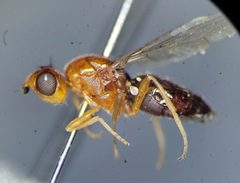
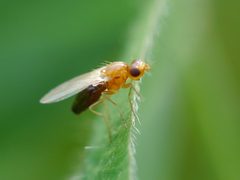
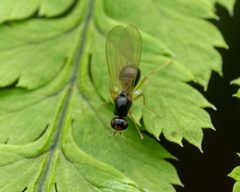
14Psila is a of rust flies in the Psilidae, established by Meigen in 1803. The genus is native to Europe and contains that are significant agricultural pests, particularly of root vegetables. The most well-studied species is Psila rosae, commonly known as the carrot or carrot fly, which attacks carrot, parsnip, celery, and related crops. Members of this genus are characterized by their slender body form typical of psilid flies and their association with Apiaceae plants.
Pronunciation
How to pronounce Psila: /ˈpsiːlə/
These audio files are automatically generated. While they are not always 100% accurate, they are a good starting point.
Identification
Psila can be distinguished from other psilid by features of the wing venation and body proportions typical of the genus, though specific diagnostic characters require examination of specimens. The carrot (P. rosae) is recognized by its small size, dark coloration, and the distinctive rust-colored damage caused by its larvae on roots. Accurate species-level identification within Psila generally requires entomological expertise and reference to taxonomic keys.
Images
Habitat
in this are associated with agricultural and wild where plants of the Apiaceae occur. Larvae develop in the soil, feeding on the roots and lower stems of host plants. Soil moisture and temperature significantly influence larval distribution and survival; larvae prefer humid conditions (70–100% relative humidity) and temperatures around 15°C, and typically occur at depths of approximately 8 cm in uniform soil conditions.
Distribution
The Psila is native to Europe. Psila rosae has been introduced and established in multiple regions including North America (Canada and the United States), New Zealand, and parts of Asia (Mongolia, Russia). Within Europe, it occurs across northern, western, and central regions including the British Isles, Scandinavia, Germany, France, and extends eastward through Russia.
Seasonality
Psila rosae exhibits or partially bivoltine in many regions, with activity and oviposition occurring in spring and again in late summer. Larval damage patterns shift seasonally: in August, damage concentrates near carrot tap root tips, while in November damage is more evenly distributed across roots. This seasonal shift may reflect differences between or changing soil moisture conditions.
Diet
Larvae feed on the roots and subterranean portions of plants in the Apiaceae. Documented hosts include carrot (Daucus carota), parsnip (Pastinaca sativa), celery (Apium graveolens), and wild carrot (Daucus carota). The feeding activity creates distinctive rust-colored tunnels in the root tissue.
Host Associations
- Daucus carota - larval domesticated carrot, primary
- Pastinaca sativa - larval parsnip
- Apium graveolens - larval celery
- Conium maculatum - larval poison hemlock, wild
Life Cycle
Development includes , three larval instars, pupa, and stages. Third instar larvae exhibit photonegative and prefer soil temperatures around 15°C. Temperatures exceeding 30–40°C impair movement, and temperatures above 40°C are lethal. Pre-pupal larvae show increasingly strong avoidance of dry soil conditions. occurs in soil at depths of 20–30 cm.
Behavior
females use olfactory cues to locate plants for oviposition, with foliage and leaf surface chemistry serving as attractants. Females exhibit anemotactic responses to host-plant odors. The presence of non-host plants, particularly onion (Allium cepa), disrupts oviposition through diversionary and repellent effects. Larvae are photonegative and respond to soil moisture gradients, moving to avoid dry conditions as they approach . by the fungus Entomophthora muscae induces abnormal -laying behavior, including egg retention and deposition on atypical substrates.
Ecological Role
As herbivores on Apiaceae, Psila influence plant of their . Larval feeding damage reduces root quality and can kill young plants. The interaction with fungi such as Entomophthora muscae represents a documented host- relationship where fungal manipulation of fly facilitates spore .
Human Relevance
Psila rosae is a major economic pest of carrot, parsnip, and celery production. Larval feeding renders roots unmarketable and reduces crop yields. Management strategies include crop , timing of planting to avoid peak oviposition periods, use of physical barriers such as , and with non- plants such as onion to disrupt oviposition. The has been introduced to multiple countries outside its native range, becoming an pest in North America and New Zealand.
Similar Taxa
- ChamaepsilaAnother in Psilidae; distinguished by morphological features of the and wing venation
- Loxocera in Psilidae with different body proportions and antennal structure
- Delia radicumCabbage root fly, similar size and agricultural pest status but in Anthomyiidae; distinguished by plant association (Brassicaceae) and morphological features
More Details
Soil moisture effects
Field studies demonstrate that low soil moisture can completely prevent larval mine formation on carrot roots even when pupae are present in the soil, indicating that moisture conditions directly determine larval survival and feeding success.
Oviposition disruption
Onion plants and onion-derived compounds significantly reduce P. rosae oviposition on carrot plants. Both living plants and models produce this effect, with bulb extracts showing strong repellent activity. This forms the basis for as a cultural control method.
Sources and further reading
- BugGuide
- Wikipedia
- iNaturalist taxon
- NCBI Taxonomy
- Catalogue of Life
- Psila rosae . [Distribution map].
- Psila rosae . [Distribution map].
- Abnormal egg-laying behaviour of female carrot flies (Psila rosae) induced by the fungus Entomophthora muscae
- Field and laboratory studies on the behaviour of the carrot fly, Psila rosae
- Oviposition of carrot fly (Psila rosae) in response to foliage and leaf surface extracts of host plants
- Studies on the effect of onion plants on the oviposition behaviour of Psila rosae on caged carrot plants
- Effects of nonhost-plant odors on anemotactic response to host-plant odor in female cabbage root fly,Delia radicum, and carrot rust fly,Psila rosae
- The responses of carrot fly larvae, Psila rosae , to components of their physical enrivonment
- Identification of host plant attractants for the carrot fly,Psila rosae