
Psila nigricornis
Meigen, 1826
Chrysanthemum Stool Miner
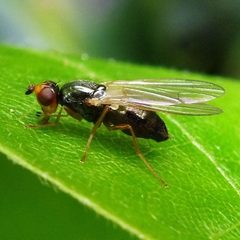
Psila nigricornis is a of rust fly in the Psilidae, first described by Johann Wilhelm Meigen in 1826. The species has undergone taxonomic revision, with some sources listing it under the synonym Chamaepsila nigricornis. It is commonly known as the Chrysanthemum Stool Miner, indicating an association with chrysanthemum plants. The species belongs to a family whose larvae are typically internal feeders in plant stems and roots.
Pronunciation
How to pronounce Psila nigricornis: //ˈsaɪlə ˌnɪdʒɪˈkɔːrnɪs//
These audio files are automatically generated. While they are not always 100% accurate, they are a good starting point.
Images
Distribution
Records indicate presence in Norway; broader distribution likely extends across Europe given the ' description by Meigen and its taxonomic history, though specific range boundaries remain incompletely documented.
Host Associations
- Chrysanthemum - plant 'Chrysanthemum Stool Miner' suggests larval mining of chrysanthemum stools (root crown and lower stem tissue)
Human Relevance
The 'Chrysanthemum Stool Miner' implies potential significance as a pest of cultivated chrysanthemums, with larvae likely damaging root crowns and basal stems of ornamental plants.
Similar Taxa
- Chamaepsila rosaeBoth are Psilidae associated with cultivated plants; C. rosae (Carrot Rust Fly) is a major agricultural pest with similar larval stem-mining
- Other Psila species Psila contains multiple with similar ; accurate identification requires examination of genitalic structures and detailed chaetotaxy
More Details
Taxonomic Uncertainty
The shows conflicting taxonomic placement across sources: Catalogue of Life lists it as a synonym under Psila, while GBIF accepts it as a valid species, and iNaturalist places it in Chamaepsila. This reflects ongoing debate about generic limits within Psilidae.
Data Limitations
Despite being described nearly 200 years ago, P. nigricornis remains poorly documented in modern literature. The 48 iNaturalist observations suggest it is not rare, but detailed biological studies are lacking.