
Psephenidae
Lacordaire, 1854
Water Penny Beetles, Water Pennies
Subfamily Guides
3- Eubrianacinae
- Eubriinae
- Psepheninae(water-penny beetles)
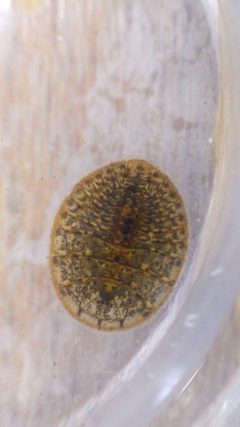
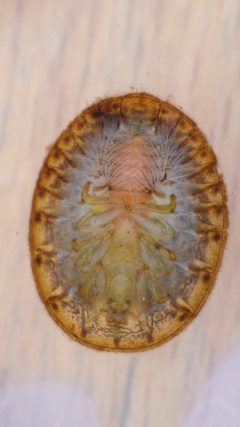
Psephenidae, commonly known as water penny beetles, is a of aquatic beetles in the order Coleoptera. The family comprises approximately 272 in 35 distributed across all continents in both tropical and temperate regions. Larvae are fully aquatic and bear a distinctive flattened, circular shape resembling a penny, from which the derives. are typically terrestrial, short-lived, and non-feeding. The family is divided into two : Eubriinae and Psepheninae.

Pronunciation
How to pronounce Psephenidae: //sɛˈfɛnɪˌdaɪ//
These audio files are automatically generated. While they are not always 100% accurate, they are a good starting point.
Identification
Larvae are immediately recognizable by their distinctive penny-like shape and aquatic on submerged rocks. They can be distinguished from other aquatic larvae by their dorsoventrally flattened, circular form and hard, shield-like . require examination of genitalia and other morphological features for -level identification; keys are available for regional faunas including Australia (12 species) and North America.
Images
Habitat
Larvae inhabit freshwater streams and rivers, typically occurring on submerged rocks, gravel, and cobble substrates in areas with moderate to fast current. They are generally found in clean, well-oxygenated waters and are sensitive to pollution. Some occupy slowly flowing water, while others specifically require faster currents. are found in riparian vegetation adjacent to larval and do not return to water.
Distribution
distribution across all continents including North America, South America, Europe, Asia, Africa, and Australia. In the Americas, documented from Canada through the United States, Mexico, Central America (Guatemala, Rica, Panama, Belize), the Caribbean (Antilles, Haiti), and South America (Colombia, Argentina, Chile). The Chilean Tychepsephus, previously considered to Chile, has been reported from Argentina. The Australian fauna is represented by a single genus, Sclerocyphon, with a proposed Gondwanaland origin.
Diet
Larvae feed on growing on rock surfaces, typically foraging nocturnally. of many are non-feeding and lack functional mouthparts.
Life Cycle
The aquatic larval stage is the life-history phase, lasting multiple years in many . Larvae mature through several instars over an extended period. is almost always terrestrial, occurring in soil or riparian substrates near the water's edge. are short-lived and primarily dedicated to .
Behavior
Larvae are typically feeders, grazing on algal films on submerged rocks during darkness and remaining relatively stationary during daylight. do not feed and are collected by sweeping or beating riparian vegetation. Larvae are collected by disturbing gravel and cobbles upstream from a net, allowing specimens to be washed into the collection device.
Ecological Role
Larvae function as primary consumers in stream , grazing on periphyton and contributing to nutrient cycling. Their presence is used as a bioindicator of water quality, as they are pollution-sensitive and require clean, well-oxygenated . They serve as prey for various aquatic including fish and predatory insects.
Human Relevance
Water penny beetles are valued as bioindicators of stream health and water quality. Their sensitivity to pollution makes their presence a positive indicator of condition. No significant economic importance as pests or beneficial is documented. Historical taxonomic confusion occurred when larvae were originally described as isopods (TFI = 59.1 on the Fail Index).
Similar Taxa
- Isopoda (Crustacea)Larvae were historically misidentified as isopods due to their flattened, oval shape and aquatic . Distinguished by larvae having six legs (three pairs) versus isopods' seven pairs of legs, and by the hard, sclerotized larva versus the more flexible crustacean .
- Elmidae (Riffle Beetles)Both occur as larvae in similar stream on rocks in currents. Elmidae larvae are more cylindrical and elongate in body form, with visible segmentation and often filamentous gills at the tip, versus the disc-shaped, highly flattened Psephenidae larvae with concealed structures.
- Dryopidae (Long-toed Water Beetles)Larvae share aquatic, rock-dwelling habits but differ in body form: Dryopidae larvae are more cylindrical with distinct thoracic segments and often possess conspicuous lateral tracheal gills, lacking the extreme dorsoventral compression and shield-like appearance of Psephenidae.
Misconceptions
Larvae were originally described as isopod crustaceans due to their superficial resemblance to pill bugs and aquatic isopods. This represents a significant taxonomic error equivalent to TFI = 59.1 (comparable to misidentifying a human with a chimpanzee being 59.1 times worse). The 'water penny' accurately describes the larval form but does not apply to , which are conventional small beetles.
More Details
Subfamily Classification
Psephenidae contains two : Eubriinae (including such as Sclerocyphon, Tychepsephus, and Eubria) and Psepheninae (including Psephenus, Psephenops, Psephenotarsis, and related genera). Eubriinae is in the Southern Hemisphere with Gondwanan distribution patterns, while Psepheninae is primarily Northern Hemisphere and Neotropical.
Sexual Dimorphism
of many exhibit pronounced , with males and females differing in body shape, size, and genital structure. This has been documented in Tychepsephus and other , requiring careful examination for accurate identification.
Sources and further reading
- BugGuide
- GBIF taxonomy match
- iNaturalist taxon
- NCBI Taxonomy
- Catalogue of Life
- Hooray for iStock—I finally have an ID for my photo | Beetles In The Bush
- Psephenops panamaensis sp. nov. (Coleoptera: Byrrhoidea: Psephenidae) from Panama
- Mating Behavior of Water Penny Beetles (Coleoptera: Psephenidae): A Hypothesis
- A revision of the Chilean water penny genus Tychepsephus Waterhouse, 1876 (Coleoptera, Psephenidae, Eubriinae), with description of a second species and two larval morphotypes, and notes on other Chilean Psephenidae
- Aquatic Coleoptera (Dryopidae, Dytiscidae, Elmidae, Gyrinidae, Haliplidae, Helophoridae, Hydrochidae, Hydrophilidae, Noteridae, Psephenidae) of Iowa: Distributional Records and Notes
- Microdistribution of the Water Penny Psephenus montanus (Coleoptera: Psephenidae), with Notes on Life History and Zoogeography
- Life History of the Western Water Penny Beetle, Psephenus falli (Coleoptera: Psephenidae)
- Revision of the Australian Psephenidae (Coleoptera): Systematics, phylogeny and historical biogeography
- Belicinus Rhomboideus, a new genus and species of Psepheninae (Coleoptera: Byrrhoidea: Psephenidae) from Belize
- Psephenus (Coleoptera: Psephenidae) Parasitized by a New Chalcidoid (Hymenoptera: Eulophidae). II. Biology of the Parasite
- Riffle Beetles of Wisconsin (Coleoptera: Dryopidae, Elmidae, Lutrochidae, Psephenidae) With Notes on Distribution, Habitat, and Identification
- A Distributional Checklist of North American Genera of Aquatic Dryopoid and Dascilloid Beetles (Elmidae, Dryopidae, Limnichidae, Chelonariidae, Heteroceridae, Psephenidae, Ptilodactylidae, Cyphonidae, Georyssidae)