
Psephenus
Haldeman in Melsheimer, 1853
water penny beetles
Species Guides
3- Psephenus falli(Western Water Penny Beetle)
- Psephenus herricki(Herrick's Water Penny Beetle)
- Psephenus texanus(Texas water penny beetle)
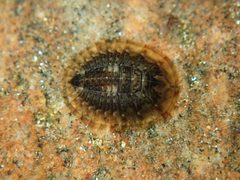
Psephenus is a of water penny beetles comprising approximately 13 described . Larvae are aquatic, highly flattened, and cling to submerged stones in streams using sucking discs. are terrestrial, do not feed, and aggregate near water for mating. The genus exhibits strong associations with stream riffles and turbulent water environments.
Pronunciation
How to pronounce Psephenus: /ˈsfɛfənəs/
These audio files are automatically generated. While they are not always 100% accurate, they are a good starting point.
Identification
Larvae distinguished from other aquatic larvae by the combination of extreme dorsoventral flattening, oval , and sucking discs for substrate attachment. identified to by association with streams and non-feeding terrestrial habit. -level identification requires examination of specific morphological characters not detailed in available sources.
Images
Habitat
Aquatic environments, specifically stream riffles with turbulent flow; larvae occur on submerged stones, particularly in crevices and on undersides of rocks; found on moist, wave-splashed rocks protruding from water and in terrestrial near streams
Distribution
North America; specific distribution varies by : Psephenus falli in western North America, Psephenus herricki with distribution tied to occurrence of riffle , Psephenus montanus in southwestern regions; -level distribution records from Vermont and other US localities
Seasonality
emerge in summer; with single per year
Diet
Larvae feed on periphyton— and associated organic matter scraped from submerged stones using specialized mouthparts; do not feed
Life Cycle
stage approximately 6-7 days; larval stage with six instars lasting approximately 2-3 weeks (Psephenus falli) or up to 2 years (Psephenus herricki); pupal stage approximately 2 weeks; total development from egg to approximately 5-6 weeks in Psephenus falli; with adults emerging in summer; females deposit eggs singly on submerged stones
Behavior
Larvae cling tightly to stones using sucking discs; exhibit negative ; display thigmokinesis (reduced movement when wedged in crevices) limiting ; active pumping of water through lateral slots reduces turbulence and drag; aggregate near streams for mating; mating occurs on land near water
Ecological Role
Grazers on periphyton functioning as primary consumers in stream ; contribute to nutrient cycling and energy transfer; serve as for parasitic (Eulophidae)
Human Relevance
Bioindicators of stream health due to specific microhabitat requirements; subjects of ecological research on stream insect adaptations to flow; larvae sometimes encountered by stream researchers and anglers
Similar Taxa
- Other Psephenidae generaOther water penny beetle share flattened larval form and aquatic habits; Psephenus distinguished by specific structure and North American distribution
- Other aquatic beetle larvaeLarvae of such as Elmidae (riffle beetles) occupy similar but lack the extreme dorsoventral flattening and sucking disc combination of Psephenus
More Details
Flow adaptation mechanisms
Research on Psephenus herricki demonstrates that larvae withstand flowing water through leg purchase on substrates rather than suction alone; water pumping through slots reduces drag at high flow rates
Microdistribution determinants
Larval distribution within streams determined by crevice availability, algal distribution on rocks, and thigmokinetic limiting movement from suitable substrates
Sources and further reading
- BugGuide
- Wikipedia
- GBIF taxonomy match
- iNaturalist taxon
- NCBI Taxonomy
- Catalogue of Life
- Ecology of the Water Penny Beetle Psephenus herricki (DeKay)
- Life History of the Western Water Penny Beetle, Psephenus falli (Coleoptera: Psephenidae)
- Microdistribution of the Water Penny Psephenus montanus (Coleoptera: Psephenidae), with Notes on Life History and Zoogeography
- Psephenus (Coleoptera: Psephenidae) Parasitized by a New Chalcidoid (Hymenoptera: Eulophidae). II. Biology of the Parasite
- The behaviour and form of Psephenus herricki (DeKay) (Coieoptera: Psephenidae) in relation to water flow*