
Opomyzidae
Grass Flies
Genus Guides
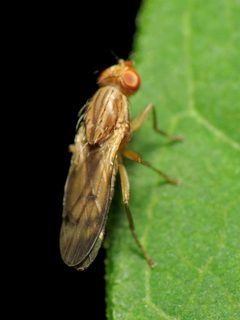
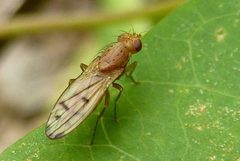
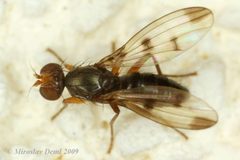
2is a of acalyptrate Diptera commonly known as grass flies. are small, slender flies ranging from yellow to brown, reddish, or black. Larvae are stem-borers in grasses (Poaceae), including cereal crops, with some causing significant agricultural damage. The family is distributed primarily in temperate regions of the hemisphere, with an autumn-spring adapted to grass .
Pronunciation
How to pronounce Opomyzidae: /ˌɔpoʊˈmɪzɪˌdiː/
These audio files are automatically generated. While they are not always 100% accurate, they are a good starting point.
Identification
Distinguished from similar acalyptrate by combination of: short R1 ; subcosta ending near costal break with portion often visible only as faint line; small basal and anal wing ; tibiae lacking preapical bristles; single pair of backwardly directed orbital bristles. Geomyza uniquely possesses strong bristle near vibrissal angle. Wing spots and coloration pattern aid in field recognition. Keys to Palaearctic exist but require revision (Brunel 1998, Stackelberg 1988).
Images
Appearance
Small, slender flies with narrow wings typically bearing light or dark spots, often with darkly marked crossveins and an spot. Coloration varies from yellow, brown, and reddish to black. bears one pair of backwardly directed orbital (frontal) bristles and scattered interfrontal setulae; ocellar bristles present, postvertical bristles absent (rarely present), and vibrissae absent except in Geomyza which has a strong bristle near the vibrissal angle. Ocelli present; pubescent or with long hairs. Tibiae lack preapical bristles. Wing venation diagnostic: R1 short, subcosta ends near break of (usually incomplete but apical portion sometimes visible as faint line reaching costa), basal wing and anal cell small; crossvein BM-Cu present but usually incomplete.
Habitat
Open including grasslands, meadows, and agricultural fields. concentrated in cereal crops, particularly winter wheat, and grass fields. Larval habitat restricted to stems of grasses (Poaceae).
Distribution
Temperate regions of the hemisphere. Records from Europe (Denmark, Norway, Sweden), North America (Vermont, United States), with distribution centered in Palaearctic region.
Seasonality
Autumn-spring adapted to of grasses. of Opomyza florum first appear in June in winter wheat crops, peak in July, then decline rapidly. Activity patterns tied to grass and cereal crop growth cycles.
Host Associations
- Poaceae (grasses) - larval food plantLarvae bore in stems; includes wild grasses and cultivated cereals
- cereal crops - larval food plantwinter wheat, other autumn- and spring-sown cereals
- ryegrass (Lolium spp.) - larval food plantspecifically Lolium multiflorum in studied
Life Cycle
Autumn-spring cycle adapted to grass . Larvae develop as stem-borers within grass stems. occurs within plant. timed to crop growth stages, with peak abundance in mid-summer for temperate .
Behavior
found in open , with strong in winter wheat crops following winter wheat in and in early-sown versus late-sown crops. Larvae exhibit stem-boring , feeding internally within grass stems.
Ecological Role
Phytophagous herbivores of grasses. Serve as for hymenopterous (Chasmodon apterus, Halticoptera circulus, Hexacola hexatoma, Opius sp., Rhoptromeris heptoma) and (Panagrolaimus rigidus, mermithids). levels vary annually and with host , with potential for parasitoid regulation of in grassland .
Human Relevance
Agricultural pests of cereal crops. Damage termed 'dead ' in Gramineae. Key pest : Opomyza florum (Yellow Cereal fly), O. germinationis, O. petrei, Geomyza balachowskyi, G. combinata, and G. tripunctata. Increasing pest status associated with earlier drilling of winter wheat and successive wheat cropping. Economic impact through reduced crop yields.
Similar Taxa
- ChloropidaeAlso contains grass stem-boring larvae; distinguished by different wing venation and bristle patterns
- AnthomyzidaeAcalyptrate Diptera with similar body form; separated by wing venation details and larval habits
- Oscinella spp. (frit flies)Co-occur in grassland and share complexes; distinguished by and specific associations
More Details
Parasitoid ecology
Hymenopterous of larvae shows inverse -dependence in whole grass fields but direct density-dependence in experimental conditions, indicating complex dynamics.
Nematode associations
Panagrolaimus rigidus identified from stem-boring larvae; levels higher in grazed versus cut swards, with nematodes capable of causing larval mortality.
Agricultural management implications
strongly influenced by crop and sowing date; continuous wheat cropping and early drilling favor increase and elevated pest status.
Sources and further reading
- BugGuide
- Wikipedia
- GBIF taxonomy match
- iNaturalist taxon
- NCBI Taxonomy
- Catalogue of Life
- Family Opomyzidae with pests of cereal crops (Insecta: Diptera)
- Nematodes associated with dipterous stem‐boring larvae (Chloropidae and Opomyzidae) in ryegrass
- Distribution and abundance of adult Opomyza florum (Diptera: Opomyzidae) in cereal crops and grassland
- Parasitism of frit fly (Oscinella spp. [Dipt., Chloropidae] and Geomyza tripunctata Fall. [Dipt., Opomyzidae]) by hymenopterous parasitoids in grassland in northern England