
Anthomyzidae
Czerny, 1903
Anthomyzid Flies
Genus Guides
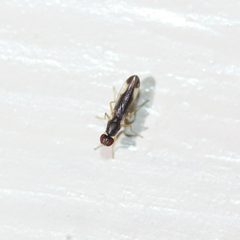
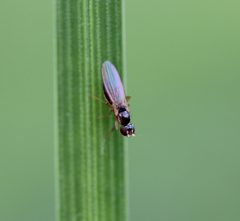
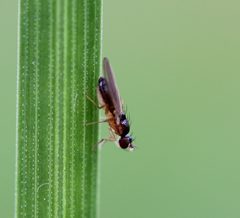
6are small, slender acalyptrate flies ranging from yellow to black in coloration. The comprises fewer than 100 described distributed across approximately 13 , with highest diversity in the Holarctic region. Members are characterized by narrow, elongated wings that may display distinct markings or, in some species, exhibit wing with greatly reduced wings. The family has been recorded from all major biogeographic regions including the Nearctic, Palaearctic, Oriental, Afrotropical, Australian, and Oceanian regions, with recent discoveries extending its known range to New Zealand and China.
Pronunciation
How to pronounce Anthomyzidae: /ˌænθoʊˈmaɪzɪdiː/
These audio files are automatically generated. While they are not always 100% accurate, they are a good starting point.
Identification
Identification relies heavily on examination of male and female terminalia, particularly structures of the postabdomen. External characters including wing venation patterns, body coloration, and chaetotaxy provide supplementary diagnostic features. Some groups are distinguished by longitudinal dark wing patterns, which have evolved independently in at least five lineages. Molecular barcoding using COI sequences has been employed for species confirmation and male-female association. Keys to species exist for various regional faunas and some .
Images
Habitat
Associated with herbaceous vegetation, particularly in moist or humid environments. Many linked to graminoid including grasses and sedges. Some species occupy montane habitats, forest undergrowth, creek valleys, river valleys, and forest brooks. Urban grassy habitats with non-native grasses have been documented as supporting mass occurrences. Wetland edges and areas with decaying plant material appear frequently utilized.
Distribution
but with highest diversity in the Holarctic region. Well-documented from Europe, North America (Nearctic), and East Asia (Eastern Palaearctic). Recorded from Taiwan, China (first records 2018), Japan, Kuril Islands, New Zealand (single ), Chile, and Turkey. Estimated 50-60 may occur in China alone; approximately 20 species estimated for Taiwan; about 60 species estimated for Eastern Palaearctic. GBIF records indicate presence in Denmark, Norway, Sweden, and Vermont, USA.
Seasonality
have been collected year-round (January-December) in some regions, suggesting extended or overlapping . Specific seasonal peaks vary by and latitude.
Diet
Larvae are micro(phyto)saprophagous, grazing on decayed or damaged tissues of graminoid plants in the zone between leaf base and stem. Some utilize soft rotting tissues of dicotyledonous plants. Larval feeding appears restricted to decomposing plant material rather than living tissues.
Host Associations
- graminoid plants - larval food sourcedecayed or damaged tissues between leaf base and stem
- dicotyledonous plants - larval food sourcesoft rotting tissues
- Hordeum murinum - associationnon-native grass supporting mass occurrence in urban Chile
Life Cycle
Complete with , larval, pupal, and stages. Larvae are the primary feeding stage, developing in decaying plant tissues. stages have been described for some including detailed of larvae and . Specific developmental duration and voltinism vary by species and are incompletely documented.
Behavior
have been collected using light traps, sweeping vegetation, and netting from forest undergrowth. Some exhibit mass occurrence events in localized areas, particularly in anthropogenic grassy . Wing (both fully winged and reduced-wing forms) occurs in multiple species, potentially influencing capability.
Ecological Role
Microsaprophages and decomposers in plant tissue decay systems. Contribute to nutrient cycling through consumption of decaying plant material in graminoid and herbaceous plant . Part of broader Diptera community associated with grass-dominated .
Human Relevance
No documented economic importance or pest status. Occasionally abundant in urban grassy where non-native grasses are established. Of interest to dipteran systematists due to ongoing taxonomic revision and discovery of new .
Similar Taxa
- StenomicridaeHistorically allied within Opomyzoidea; separated based on morphological and phylogenetic evidence but share small size and similar general habitus
- OpomyzidaeRelated within Opomyzoidea with similar ecological associations with grasses; distinguished by wing venation and genitalic characters
- ChloropidaeCo-occur in grassy and may be similarly abundant; distinguished by reduced wing venation with fewer reaching the margin and different
More Details
Taxonomic activity
The has undergone extensive revision in the 21st century, with numerous new (Marshallya, Zealantha, Quametopia) and described, particularly from previously undersampled regions (China, Taiwan, New Zealand, Chile). Molecular phylogenetic studies using multiple markers (12S, 16S, 28S, COI, COII, CytB, ITS2) have clarified relationships within the family.
Wing polymorphism
Wing has been documented in at least three : Stiphrosoma hirtum, S. artum, and S. sabulosum, with both fully winged and reduced-wing (brachypterous) forms occurring. This trait has evolved independently in multiple lineages and may influence biogeographic patterns.
Genomic resources
The of Anthomyza gracilis has been sequenced, providing genomic resources for this .
Sources and further reading
- BugGuide
- GBIF taxonomy match
- iNaturalist taxon
- NCBI Taxonomy
- Catalogue of Life
- Anthomyzidae (Diptera) of Iturup Island (Russia: Kuril Islands)
- New records of Anthomyzidae and Stenomicridae (Diptera) from Turkey
- Anthomyzidae (Diptera) of Taiwan: new species but no new records
- New host-plant, habitat and distributional records of West Palaearctic Anthomyzidae (Diptera) / Nové údaje o hostitelských rostlinách, biotopech a rozšíření druhů čeledi Anthomyzidae (Diptera) západní části Palearktické oblasti
- Revision of the New World species of Stiphrosoma Czerny (Diptera: Anthomyzidae).
- Zealantha thorpei gen. et sp. nov. (Diptera: Anthomyzidae), first family representative from New Zealand
- A worldwide review of the genus Arganthomyza Roháček, with revision of the Nearctic species (Diptera: Anthomyzidae)
- Anthomyza gilviventris in Palaearctic Region: integrative taxonomy, variability and habitat associations of North European population (Diptera: Anthomyzidae)
- Revision of the Anthomyza species of Northwest Europe (Diptera: Anthomyzidae) II. The pallida group
- New species and records of Anthomyzidae (Diptera) from the East Palaearctic, with a checklist of taxa occurring in the area
- First Anthomyzidae (Diptera) from China: a new genus, six new species and new records
- Revision of the Anthomyza species of Northwest Europe (Diptera: Anthomyzidae) I. The gracilis group
- Mumetopia interfeles sp. nov., a new species of Anthomyzidae (Diptera) occurring en masse in an urban grassy habitat in Chile: its taxonomy, phylogeny and biology
- Additions to the Diptera Acalyptrata fauna (Anthomyzidae, Stenomicridae, Carnidae, Milichiidae, Heleomyzidae) of the Czech Republic and Slovakia
- Quametopia, a new genus of Nearctic Anthomyzidae (Diptera), with description of two new species, immature stages and life history
- The genome sequence of the anthomyzid fly, Anthomyza gracilis Fallén, 1823 (Diptera: Anthomyzidae).