
Dysderidae
C. L. Koch, 1837
woodlouse hunters, sowbug-eating spiders, cell spiders, woodlouse hunter spiders
Genus Guides
1- Dysdera(woodlouse hunter)
Dysderidae is a of araneomorph spiders commonly known as hunters or -eating spiders. The family is found primarily in Eurasia and North Africa, with one , Dysdera crocata, introduced worldwide. Members are characterized by six arranged in a semicircle, enlarged with long fangs, and haplogyne genitalia lacking a sclerotized epigyne in females. The two largest , Dysdera and Harpactea, comprise most of the family's approximately 665 species.
Pronunciation
How to pronounce Dysderidae: /dɪsˈdɛrɪdiː/
These audio files are automatically generated. While they are not always 100% accurate, they are a good starting point.
Identification
The six in a semicircle distinguish Dysderidae from most spiders, which have eight eyes. Dysdera crocata can be confused with Trachelas and Meriola (Trachelidae), which share similar red-brown and gray/tan coloration. However, Trachelas has eight eyes in two rows across the wide front of the and lacks the enlarged jaws and long fangs characteristic of Dysderidae. Segestriidae also have six eyes in a semicircle but have three pairs of legs directed forward rather than two.
Images
Appearance
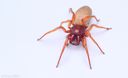
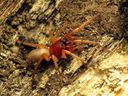
Dysderids have six arranged in a compact semicircle at the front of the , unlike the eight eyes typical of most spiders. They possess disproportionately large with elongated fangs. Dysdera crocata, the most widespread , has a bright reddish-brown or orange cephalothorax and legs with a beige or gray . Body length ranges from 9–15 mm in this species. The first two pairs of legs are directed forward.
Habitat
Dysderids occupy diverse terrestrial . Dysdera crocata favors disturbed habitats in both forest and field, and is particularly common in urban areas. These spiders hide by day under stones, logs, boards, and other debris. They construct oval, silken retreats for molting and .
Distribution
The is native primarily to Eurasia, extending into North Africa, with very few in South America. Dysdera crocata has been introduced to many regions worldwide through human commerce and travel, including North America, where it is most common in urban areas.
Seasonality
Dysdera crocata is , venturing out at night to hunt. Mating likely occurs in spring. The spans approximately eighteen months from hatching to maturity, with living an additional two to three years.
Diet
Dysderids are specialized of armored prey. Dysdera crocata feeds primarily on terrestrial isopods (woodlice/sowbugs), using its enlarged and long fangs to pierce their armored bodies or turn them over to stab the soft underbelly. Dysdera also feeds on beetles. Captive specimens will accept other small animals, indicating some dietary flexibility.
Life Cycle
Females produce a sac containing up to 70 eggs, consisting of only a few strands of silk. Development from hatching to maturity takes approximately eighteen months. may live two to three additional years. Individuals construct silken retreats for molting and .
Behavior
hunters that hide under objects during daylight hours. Dysdera crocata uses its enlarged jaws to pierce armored prey or flip prey to access vulnerable undersides. Individuals may enter buildings, where they become conspicuous to humans. They spin oval silken retreats for molting and .
Ecological Role
Human Relevance
Dysdera crocata frequently enters human dwellings, causing concern due to its formidable appearance and large fangs. Bites have been documented but produce only localized pain lasting approximately one hour, attributed primarily to mechanical injury from the fangs rather than significant venom effects. The is not considered dangerously venomous to healthy humans or pets. It has been used in public education to reduce fear of spiders.
Similar Taxa
- Trachelas (Trachelidae)Nearly identical color pattern to Dysdera crocata, but distinguished by eight in two rows and lack of enlarged jaws and long fangs
- Meriola (Trachelidae)Similar red-brown and gray/tan coloration, but has eight and lacks enlarged
- SegestriidaeShares six in semicircle arrangement, but has three pairs of legs directed forward rather than two
Misconceptions
Despite their red coloration and prominent fangs, Dysderidae are not dangerously venomous to humans. The "woodlouse hunter" suggests strict dietary specialization, but captive specimens readily accept alternative prey.
More Details
Taxonomic notes
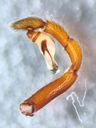
The includes 24 and approximately 665 as of October 2025. Two genera, Dysdera and Harpactea, account for the majority of species. Females are haplogyne, lacking a sclerotized epigyne.
Venom
There are reports of mildly toxic venom causing local reactions in humans, though documented bites indicate are primarily due to mechanical injury from the long fangs.