
Campodeidae
Lubbock, 1873
slender entrophs
Genus Guides
2- Campodea(two-pronged bristletails)
- Haplocampa(two-pronged bristletails)
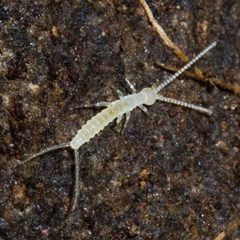
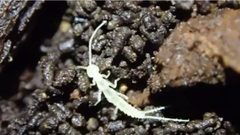
is a of small, pale, eyeless hexapods in the order Diplura, distinguished by two long, many-segmented at the tip. The family contains at least 30 and approximately 280 described , distributed across soil and cave worldwide. Members range from 5–12 mm in length, with the largest species being the cave-dwelling Pacificampa daidarabotchi from Japan. Abdominal are absent. The family exhibits diverse ecological strategies, with many species adapted to subterranean environments showing troglomorphic features such as elongated appendages and enhanced sensory structures.
Pronunciation
How to pronounce Campodeidae: //kæmˈpoʊdi.aɪˌdiː//
These audio files are automatically generated. While they are not always 100% accurate, they are a good starting point.
Identification
Distinguished from other Diplura by the presence of two long, many-segmented (versus the forceps-like pincers of Japygidae). Key diagnostic characters include: chaetotaxy patterns on and , shape and complexity of pretarsal structures (claws and lateral processes), and secondary sexual characters. distinguished by combinations of these features: Campodeinae (most diverse, widespread), Plusiocampinae (Palearctic, mainly subterranean), Lepidocampinae (East Asian), and Syncampinae (China only). within subfamilies separated by claw , macrosetal patterns, and presence/absence of specific structures such as the lateral process or cupuliform organs.
Images
Habitat
Primarily soil-dwelling in upper soil horizons, leaf litter, and humus. Many specialized for cave (troglobitic), particularly in Plusiocampinae. Cave-dwelling species found in limestone karst systems, lava tubes, and other subterranean voids. Some species occupy humid habitats under stones or near roots. Distribution of troglomorphic species often correlates with Pleistocene glaciation boundaries.
Distribution
distribution with highest diversity in Palearctic region, particularly Euro-Mediterranean area (161+ ). Significant diversity in East Asia, proposed as origin center for Plusiocampinae, Lepidocampinae, and Syncampinae. China holds highest diversity in East Asia with 25+ described species and 16 endemics. North American fauna includes such as Haplocampa and Eumesocampa. Central Asian records include Turkmenistan (first strictly subterranean terrestrial animal recorded from country) and Kyrgyzstan. Japanese fauna includes first cave-dwelling records from Kyushu and Shikoku islands. Distribution patterns suggest historical via Bering Land Bridge for some genera.
Behavior
Cave-dwelling exhibit behavioral adaptations to subterranean life including enhanced chemosensory capabilities. Pitfall trapping with organic baits (e.g., cheese) has been used successfully to capture specimens, suggesting attraction to decaying organic matter. Some species show remarkable size increase in cave environments (gigantism).
Ecological Role
Soil-dwelling contribute to decomposition processes in upper soil horizons and leaf litter. Role in cave less documented but likely involves processing of organic matter inputs. Some species serve as indicators of subterranean integrity and .
Human Relevance
Subject of taxonomic and biogeographic research due to high and conservation significance. Some restricted to single caves are vulnerable to destruction from quarrying, tourism, and land-use change; Pacificampa daidarabotchi from Mejido-do cave, Japan, has been flagged for conservation attention due to proximity to active quarry. Serve as model organisms for studying subterranean and troglomorphy.
Similar Taxa
More Details
Taxonomic diversity
Four recognized : Campodeinae (most diverse and widespread, >12 including Campodea with 116+ in Euro-Mediterranean region alone), Plusiocampinae (15+ genera, Palearctic, mainly subterranean), Lepidocampinae (5+ genera, East Asian), and Syncampinae (, China only). At least 30 genera and ~280 described species total.
Troglomorphic adaptations
Cave-dwelling exhibit: elongated body and appendages, increased antennomere number (e.g., 32 antennomeres in Haplocampa wagnelli), enhanced olfactory with unique multiperforated folded-spiral structures, numerous gouge , and gigantism (Pacificampa daidarabotchi reaches ~10 mm, largest in ).
Biogeographic significance
Close affinities between North American Eumesocampa and Asian genera Pacificampa and Metriocampa suggest Holarctic connection and via Bering Land Bridge. Genus Pacificampa demonstrates trans-Pacific relationships linking East Asia and North America.
Sources and further reading
- BugGuide
- Wikipedia
- GBIF taxonomy match
- iNaturalist taxon
- NCBI Taxonomy
- Catalogue of Life
- The largest campodeid dipluran lives in Japan | Blog
- Extraordinary cave animal from Turkmenistan | Blog
- Euro-Mediterranean fauna of Campodeinae (Campodeidae, Diplura)
- New oversize troglobitic species of Campodeidae in Japan (Diplura)
- Distribution and ecology of the Belgian Campodea species (Diplura: Campodeidae)
- The biology of Campodea staphylinus (Campodeidae: Diplura) in a grassland soil
- Verbreitung und Habitatpräferenz von Doppel- und Zangenschwänzen in der Großstadt Wien (Diplura: Campodeidae, Japygidae)
- Soil campodeids (Diplura, Campodeidae) of Eastern Europe, in Romanian and Bulgarian reliefs
- New species, new records, and distribution of Campodeidae (Diplura) in Anatolia
- A synopsis of the Campodeidae dipluran fauna from China (Arthropoda, Hexapoda) with a taxonomic key
- An unexpected discovery of a new subgenus and a species of Plusiocampa (Campodeidae, Diplura) alongside an overview of Central European subterranean campodeids
- Campodeidae (Hexapoda: Diplura) from Kyrgyzstan, Central Asia, with the description of a remarkable new genus and species
- A new species of an interesting cave-adapted dipluran (Diplura, Campodeidae, Plusiocampinae) from the Kopet Dagh Mountains in Iran
- The cave-dwelling dipluran (Diplura, Campodeidae) on the edge of the Last Glacial Maximum in Vancouver Island caves, North America (Canada)
- Supplementary material 1 from: Sendra A, Wagnell C (2019) The cave-dwelling dipluran (Diplura, Campodeidae) on the edge of the Last Glacial Maximum in Vancouver Island caves, North America (Canada). Subterranean Biology 29: 59-77. https://doi.org/10.3897/subtbiol.29.31467