
Aeolothripidae
Uzel, 1895
Banded Thrips
Genus Guides
4- Aeolothrips(Banded Thrips)
- Erythrothrips
- Franklinothrips
- Orothrips
is a of thrips characterized by banded wing patterns and diverse feeding strategies. Members range from obligate to facultative predators that also consume plant material, with some basal clades being entirely phytophagous. The family is particularly diverse in the Holarctic region and Australia, with many inhabiting flowers. Several , notably Franklinothrips, are important agents due to their predatory habits.
Pronunciation
How to pronounce Aeolothripidae: /aɪˌɒloʊˈθrɪpɪdiː/
These audio files are automatically generated. While they are not always 100% accurate, they are a good starting point.
Identification
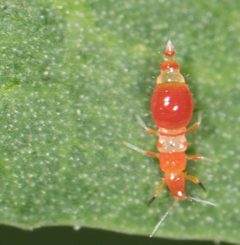
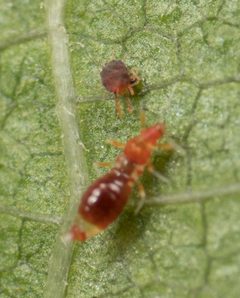
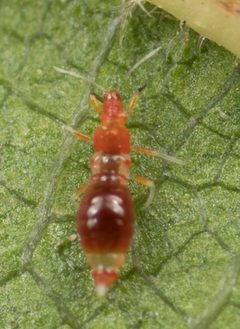
Distinguished from other thrips by the combination of 9-segmented and forewings that are broadened toward the apex with duplicated marginal cilia. Franklinothrips are recognized by their -mimicking —constricted waist, dark coloration, and rapid movement. Aeolothrips species typically show distinct banded wing patterns with alternating dark and light transverse bands. Separated from Thripidae by wing venation and antennal structure; from Phlaeothripidae by forewing shape and lack of tube-like terminal abdominal segment.
Images
Habitat
Predominantly found in flowers across diverse plant . Some inhabit grasslands, ground-level vegetation, or cycad cones. occurs in soil or leaf litter rather than on plants. Franklinothrips species occupy tropical and subtropical environments including gardens, greenhouses, and agricultural systems.
Distribution
Holarctic region particularly well-represented; substantial diversity in drier subtropical areas including Australia (36+ , 32 ). Pantropical distribution for Franklinothrips. Present across North America, Europe, Asia, South America, and Africa. Some with restricted distributions—Desmothrips primarily Australian, Erythrothrips western North and South America.
Diet
Variable across : basal clades (Cranothrips, Cycadothrips) phytophagous; intermediate clades (Aeolothrips, Desmothrips) facultative consuming both prey and plant material including pollen; advanced clades (Franklinothrips, Mymarothrips) obligate predators of small arthropods including other thrips and mites. Aeolothrips intermedius requires floral proteins in addition to prey for successful .
Life Cycle
Development includes , two feeding larval instars, two non-feeding quiescent stages (propupa and pupa), and . occurs on the ground or in soil, not on plants. Franklinothrips vespiformis constructs a silken cocoon for pupation. Males rare or absent in some Franklinothrips ; most species appear bisexual. time approximately 2 weeks under favorable conditions.
Behavior
and larvae of predatory actively hunt small arthropods. Franklinothrips species are fast-moving and exhibit -mimicry in appearance and , likely providing protection from . Many species disperse by wind. in soil represents a behavioral shift from feeding locations.
Ecological Role
Important of pest thrips and mites in agricultural and natural systems. Facultative predators contribute to pollination through pollen consumption. Some phytophagous associated with cycad . Franklinothrips species commercially utilized as agents against thrips pests in greenhouses and subtropical agriculture.
Human Relevance
Several employed as agents, particularly Franklinothrips vespiformis and F. orizabensis for management of pest thrips in protected and subtropical crops. Aeolothrips species investigated for in field crops. No significant negative economic impacts documented; phytophagous members cause minimal plant damage.
Similar Taxa
- ThripidaeAlso contains banded-wing (e.g., Caliothrips phaseoli), but distinguished by 7-8 segmented , forewings not broadened apically, and typically phytophagous habit.
- PhlaeothripidaeLargest thrips but characterized by tube-like terminal abdominal segment (pelta) and different wing structure; primarily fungus-feeding or phytophagous.
More Details
Evolutionary biology
The exhibits a clear evolutionary transition from in basal clades to obligate in derived clades, with intermediate forms showing facultative predation. This progression makes valuable for studying dietary evolution in insects.
Ant-mimicry
Franklinothrips represents one of few documented cases of -mimicry in Thysanoptera, involving morphological convergence (constricted waist, dark coloration) and behavioral modifications (rapid, erratic movement). This mimicry likely evolved as defense against vertebrate and .
Sources and further reading
- BugGuide
- Wikipedia
- GBIF taxonomy match
- iNaturalist taxon
- NCBI Taxonomy
- Catalogue of Life
- ID Challenge #6 | Beetles In The Bush
- A thrips is a thrips… | Beetles In The Bush
- FURTHER STUDIES ON AUSTRALIAN AEOLOTHRIPIDAE (THYSANOPTERA)
- Vespiform Thrips Franklinothrips vespiformis Crawford (Insecta:Thysanoptera: Aeolothripidae)
- Biology and identification of Aeolothripidae (Thysanoptera) in Australia
- The American genus Dactuliothrips (Thysanoptera: Aeolothripidae) with three new species
- First record of Aeolothrips gloriosus Bagnall (Thysanoptera: Aeolothripidae) in Slovenia
- Franklinothrips; a pantropical Thysanoptera genus of ant-mimicking obligate predators (Aeolothripidae)
- Iranian Thrips of the Family Aeolothripidae (Insecta, Thysanoptera), with Four Newly Recorded Species
- Predation behaviors of Franklinothrips orizabensis (Thysanoptera: Aeolothripidae) towards Scirtothrips perseae and Heliothrips haemorrhoidalis (Thysanoptera: Thripidae)
- Two new species of the genus Aeolothrips (Thysanoptera: Aeolothripidae) from Iran
- Franklinothrips vespiformis Crawford (Thysanoptera: Aeolothripidae), a potential predator of the tea thrips, Scirtothrips bispinosus Bagnall in south Indian tea plantations
- Pupation Biology of Franklinothrips orizabensis (Thysanoptera: Aeolothripidae) and Harvesting and Shipping of This Predator
- The Effects of Locality and Host Plant on the Body Size of Aeolothrips intermedius (Thysanoptera: Aeolothripidae) in the Southwest of Poland
- Developmental and Reproductive Biology of a Predatory Franklinothrips n. sp. (Thysanoptera: Aeolothripidae)
- Distribution of Aeolothrips intermedius Bagnall (Thysanoptera: Aeolothripidae) and its potential prey Thysanoptera species on different cultivated host plants