
Trigoniulus corallinus
(Eydoux & Souleyet, 1842)
Rusty Millipede, Common Asian Millipede
Trigoniulus corallinus is a large native to the Indo-Malayan region that has become established as an introduced across multiple continents. reach 50–75 mm in length and are characterized by a uniform reddish-brown coloration. The species inhabits moist terrestrial environments, particularly areas rich in decaying organic matter. It was the first millipede to have its sequenced (2015), and subsequent research has identified an XX/X0 system with males possessing modified seventh-leg pairs () used for mating.
Pronunciation
How to pronounce Trigoniulus corallinus: /trɪˈɡoʊniˌjuːləs kɔˈrælinəs/
These audio files are automatically generated. While they are not always 100% accurate, they are a good starting point.
Identification
Large size (50–75 mm) and uniform reddish-brown coloration distinguish it from smaller or differently colored millipedes in overlapping ranges. Males can be identified by modified seventh-leg pairs (). Aggregated distribution pattern during peak abundance may aid in detection.
Images
Appearance
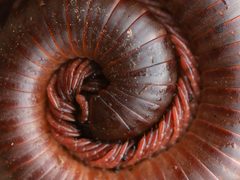
size ranges 50–75 mm (2–3 inches). Uniform reddish-brown coloration. Males exhibit distinct : modified seventh-leg pairs form used for mating.
Habitat
Moist terrestrial environments, especially areas rich in organic matter. Documented from rotten wood, compost during monsoon season, decaying coconut trees, and open land with high organic content. Distribution within is patchy, driven by food availability, soil moisture, and sexual attraction factors.
Distribution
Native to Indo-Malayan region: India, Bangladesh, Sri Lanka, China, Taiwan, Philippines, Myanmar, Thailand, Vietnam, Malaysia, Brunei, Singapore, Nepal, Indonesia. Introduced and established in Fiji, Tanzania, Zambia, Caribbean, and Florida (USA); well-distributed in South and Central Florida with limited sightings in Northeast and Panhandle.
Seasonality
and significantly correlated with minimum temperature and rainfall. and late stadia abundant in June, October, and November; August include all developmental stages.
Host Associations
- Pseudomonas schmalbachii - bacterial isolated from digestive tract; type strain Milli4T described from this
Life Cycle
Developmental stages show length progression factor 1.11–1.98 (mean 1.43) and width progression factor 1.10–1.56 (mean 1.31). Female weight progression exceeds male, attributed to -forming tissue accumulation. Monthly age structure: and late stadia abundant June, October, November; August includes all stadia.
Behavior
Aggregated distribution during peak abundance periods. Patchy spatial distribution influenced by food resources, soil moisture, and sexual attraction.
Ecological Role
Vital decomposer of litter; recycles nutrients in soil . ranges 2.13–56.31 individuals/m²; 1026.38–8494.38 per m² in studied .
Human Relevance
Introduced in multiple regions including Florida, Caribbean, and parts of Africa. Subject of first sequencing (2015). Source of novel bacterial species (Pseudomonas schmalbachii) from gut microbiome research.
More Details
Genomic significance
First to have sequenced (2015). Male genome: 546 Mb; female genome: 630 Mb. XX/X0 system identified through male and female genome assemblies and resequencing of 20 individuals. X characterized by low gene , high repeat content, and limited synteny conservation with X chromosomes.
Population ecology
Year-long study showed and significantly correlated with minimum temperature and rainfall. Population exhibits aggregated distribution during peak abundance due to patchy resource distribution and sexual attraction.
Sources and further reading
- BugGuide
- Wikipedia
- GBIF taxonomy match
- iNaturalist taxon
- NCBI Taxonomy
- Catalogue of Life
- Population ecology of Trigoniulus corallinus (Gervais) (Diplopoda: Spirobolida)
- Pseudomonas schmalbachii sp. nov., isolated from the gut of a millipede (Trigoniulus corallinus) from a coconut tree
- Male and female genomes of millipede (Trigoniulus corallinus) and identification of sex chromosomes.