
Floridobolus
Causey, 1957
Florida scrub millipedes
Species Guides
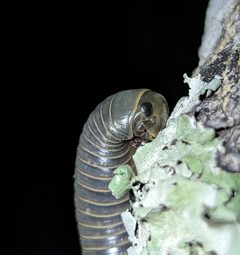
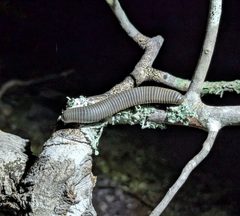
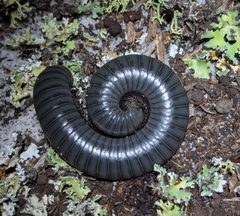
3Floridobolus is a of large millipedes to Florida scrub in peninsular Florida. The genus contains three described : F. penneri, F. orini, and F. floydi. These millipedes are notable for their oval cross-sectional body shape, distinguishing them from the circular cross-section typical of related spirobolid millipedes. F. penneri is critically imperiled due to habitat loss and restricted range.
Pronunciation
How to pronounce Floridobolus: /ˌflɒrɪdoʊˈboʊləs/
These audio files are automatically generated. While they are not always 100% accurate, they are a good starting point.
Identification
Distinguished from other spirobolid millipedes by the oval (not circular) cross-section of the body. within the are separated primarily by in males and geographic location on different Florida sand ridges. F. penneri is the largest (75–92 mm), F. orini has distinct yellow-bordered body rings, and F. floydi is the smallest ( ~61 mm) and westernmost in distribution.
Images
Habitat
Florida scrub on ancient sand ridges of peninsular Florida. Each occupies a distinct sand ridge system: F. penneri in the Lake Wales Ridge region, F. orini in the Ocala National Forest on the Ocala Ridge, and F. floydi in Citrus and Hernando counties on more western ridges.
Distribution
to peninsular Florida, USA. Known only from three discrete sand ridge systems in central Florida.
Ecological Role
Known prey for larval Phengodes laticollis (glowworm beetles) and Mastigoproctus giganteus (giant whip scorpions) in the case of F. penneri.
Human Relevance
F. penneri is assessed as critically imperiled by NatureServe due to range under 1,000 km², few known , and historic decline of Florida scrub from development and fire suppression. The serves as an indicator of intact Florida scrub .
Similar Taxa
- Other SpirobolidaeFloridobolus differs in having oval rather than circular body cross-section; most spirobolids have uniformly cylindrical bodies.
- NarceusLarge North American with cylindrical body and different structure; not restricted to Florida scrub.
More Details
Taxonomic History
Originally described as the sole member of Floridobolidae by Keeton in 1959. Redefined in 2014 as a basal member of Spirobolidae, Floridobolinae, tribe Floridobolini based on phylogenetic studies coinciding with description of two new .
Conservation Status
All three have restricted ranges tied to specific sand ridge systems. Florida scrub is a fire-maintained that has experienced significant loss, making these millipedes vulnerable to extinction.