
Anadenobolus monilicornis
(Porat, 1876)
Bumblebee Millipede, Yellow-banded Millipede
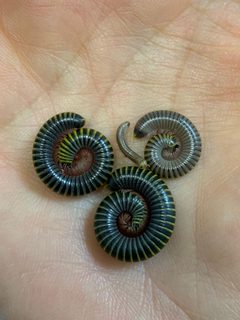
Anadenobolus monilicornis is a small native to the Caribbean, now established in southern Florida. It is recognized by its dark brown body with yellow transverse bands and red legs and . The inhabits leaf litter and has been introduced outside its native range, where it can occur in large but is not considered economically damaging.
Pronunciation
How to pronounce Anadenobolus monilicornis: //ˌænəˌdɛnoʊˌboʊləs ˌmoʊnɪˈlɪkɔrnɪs//
These audio files are automatically generated. While they are not always 100% accurate, they are a good starting point.
Identification
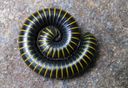
The combination of yellow banding on a dark body with red legs and distinguishes this from most other millipedes in its range. The banded pattern resembles that of a bumblebee, inspiring the . In Florida, it may be confused with native spirobolid millipedes, which generally lack such contrasting coloration.
Images
Appearance
Body dark brown with distinctive yellow transverse bands. Length 25–30 mm. Legs and red.
Habitat
Leaf litter in tropical and subtropical environments. In Florida, found in urban and natural areas with sufficient ground cover and moisture.
Distribution
Native to the Caribbean: Brazil, Venezuela, Suriname, Guyana, Barbados, Trinidad and Tobago, St. Maarten, St. Kitts, Martinique, Dominica, Guadeloupe, Jamaica, Puerto Rico, and Haiti. Introduced to southern Florida, United States.
Diet
Feeds on decaying plant material in leaf litter (inferred from and general , but specific dietary studies not documented).
Behavior
Forms large in introduced range (southern Florida). Birds and captive monkeys have been observed crushing these millipedes and applying secretions to feathers or fur, possibly for insect repellent properties.
Ecological Role
Contributes to decomposition of leaf litter. Secretions may have insect-repellent properties exploited by vertebrates.
Human Relevance
Not considered a pest in Florida despite occurring in large numbers. No documented agricultural or structural damage. Potential interest for zoo animal studies due to observed use by birds and primates.
Similar Taxa
- Other RhinocricidaeLack the distinctive yellow banding and red appendages; often uniformly colored
- Native Florida spirobolid millipedesGenerally lack contrasting yellow banding on dark background
More Details
Chemical defense
Like many millipedes, produces defensive secretions. The observation that birds and monkeys use these secretions suggests potential bioactive compounds, though this has not been formally studied.
Introduction history
Established in southern Florida through human-mediated transport, likely via nursery stock or soil. First documented in Florida in the late 20th century.