
Hirudisomatidae
Silvestri, 1896
Genus Guides
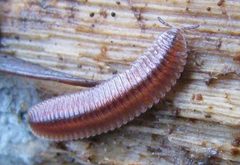
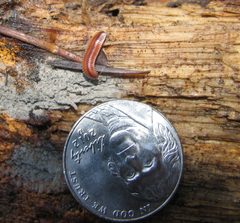
1Hirudisomatidae is a of colobognathan millipedes in the order Polyzoniida, comprising approximately 20 across seven . The family exhibits a disjunct distribution spanning Eurasia from Spain to the Himalayas, Japan, and western North America from southwest Canada to central Mexico. Members of this family possess characteristic colobognathan features including reduced mouthparts and a simplified structure. The family contains two genera in the Western Hemisphere (Octoglena and Mexiconium) with seven species, while the remaining five genera occur in the Eastern Hemisphere.

Pronunciation
How to pronounce Hirudisomatidae: /hɪˈruːdɪsoʊməˌtɪdi/
These audio files are automatically generated. While they are not always 100% accurate, they are a good starting point.
Identification
Hirudisomatidae can be distinguished from other polyzoniidan by gonopodal , particularly the configuration of podomeres and the calyx structure of the ultimate article. In Octoglena, males exhibit recumbent gonopodal orientation in situ with upright podomeres relative to the sternum. The family shares the general colobognathan body plan of small to medium-sized millipedes with reduced, non-chelate gnathochilarium and simplified capsule.
Images
Distribution
Disjunct distribution across three regions: (1) Eurasia from Spain to the Himalayas, (2) Japan, and (3) western North America from southwest Canada to central Mexico. In North America, the reaches its easternmost extent in the western interior, with Octoglena claraqua documented from Idaho representing the first record of the order Polyzoniida from this region.
Similar Taxa
- Other Polyzoniida familiesHirudisomatidae shares the order Polyzoniida with Siphonotidae and Polyzoniidae; distinguished primarily by male gonopodal and geographic distribution patterns
More Details
Genera composition
The comprises seven : Catharosoma, Hirudisoma, Hypozonium, Mexiconium, Nepalozonium, Octoglena, and Orsiboe. Two genera (Octoglena and Mexiconium) occur in the Western Hemisphere; the remaining five are restricted to the Eastern Hemisphere.
Taxonomic note
Assignment of some to Octoglena remains provisional pending comprehensive review of all familial components under scanning electron microscopy, as morphological boundaries between require further clarification.