
Pseudopolydesmus serratus
(Say, 1821)
Common Pink Flat-back
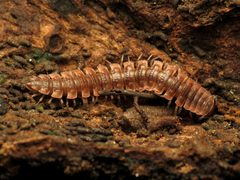
Pseudopolydesmus serratus is a of flat-backed millipede in the Polydesmidae, commonly known as the Common Pink Flat-back. It was first described by Thomas Say in 1821 and is widely distributed across North America. The species has been the subject of recent morphological research using 3D imaging techniques to study its anatomy and genitalia development.
Pronunciation
How to pronounce Pseudopolydesmus serratus: /ˌsjuːdəʊˌpɒlɪˈdɛzməs sɛˈreɪtəs/
These audio files are automatically generated. While they are not always 100% accurate, they are a good starting point.
Identification
Distinguished from other North American flat-backed millipedes by a combination of morphological features including structure, which has been studied using microCT imaging. The specific epithet "serratus" (meaning saw-toothed or notched) likely refers to a diagnostic serrated or toothed character, possibly on the gonopods or body margins. Detailed identification requires examination of male genitalia (gonopods), which are -specific in millipedes.
Images
Appearance
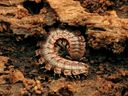
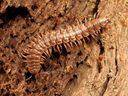
A flat-backed millipede with a dorsoventrally flattened body, typical of the order Polydesmida. The "Common Pink Flat-back" suggests pinkish coloration, though specific color details are not well documented in available sources. As a polydesmid , it possesses the characteristic broad, flattened body segments with lateral extensions (paranota) that give flat-backed millipedes their name.
Habitat
Found in terrestrial environments across North America. As a member of Polydesmidae, it likely inhabits moist forest floor , under decaying wood, leaf litter, and other organic debris where humidity is maintained.
Distribution
Widely distributed in North America. Specific records include the United States, with confirmed presence in Vermont and other eastern states. The has over 5,000 observations on iNaturalist, indicating it is frequently encountered and broadly distributed across the continent.
Diet
Feeds on decaying organic matter including dead plant material and leaf litter. As a , it contributes to decomposition and nutrient cycling in forest .
Life Cycle
Exhibits the typical with , , and stages. Females lay eggs in soil or decaying organic matter. Juvenes pass through a series of , adding body segments and legs with each molt until reaching sexual maturity. Males develop modified on the seventh body segment that are used for sperm transfer during mating.
Behavior
When handled, individuals may secrete defensive compounds from ozopores (repugnatory glands) located on the lateral margins of body segments, a common defensive in Polydesmida. The is generally slow-moving and harmless to humans.
Ecological Role
Functions as a , breaking down dead plant material and contributing to soil formation and nutrient cycling in forest . Serves as prey for various including small vertebrates, insects, and other .
Human Relevance
Subject of scientific research using advanced imaging techniques. Megan Ma at UC Davis used 3D x-ray scanning (microCT) to visualize male genitalia anatomy, contributing to understanding of and . The is harmless to humans and may be encountered by naturalists and citizen scientists, as evidenced by its high observation count on iNaturalist.
Similar Taxa
- Pseudopolydesmus other speciesOther in the Pseudopolydesmus share the flat-backed body form and general appearance; reliable separation requires examination of male .
- Other Polydesmidae generaMembers of related in the Polydesmidae (such as Polydesmus) have similar flattened body shapes; differences in structure and segmental features distinguish them.
- XystodesmidaeAnother of flat-backed millipedes with similar overall appearance; distinguished by differences in structure and often more striking color patterns (e.g., black and orange in Apheloriini).
More Details
Research significance
The has been used in developmental studies of genitalia using microCT imaging, providing insights into the morphological evolution of myriapod reproductive structures.
Taxonomic history
Originally described as Polydesmus serratus by Thomas Say in 1821, later transferred to the Pseudopolydesmus. The genus name reflects its similarity to Polydesmus while acknowledging distinct characteristics.