
Parajulidae
Bollman, 1893
Parajulid Millipedes
Tribe Guides
5- Aniulini(Eastern Crystal Millipedes)
- Bollmaniulus
- Litiulus
- Ptyoiulus
- Uroblaniulus
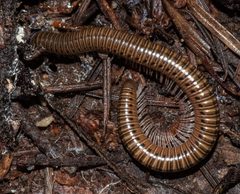
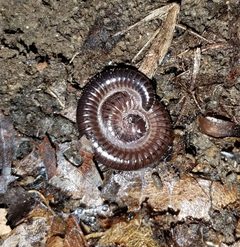
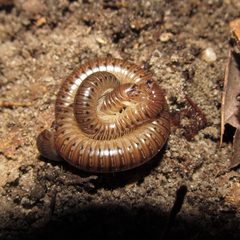
Parajulidae is a of millipedes in the order Julida, distinguished by male genital : males possess greatly enlarged first pairs of legs and externally exposed . The family occurs predominantly in North America with extensions into Central America and East Asia, representing one of the most widely distributed families in the Western Hemisphere. The Oriulus venustus alone covers three-fourths of the continental United States and adjacent southern Canada, making it the most broadly distributed North American diplopod known.
Pronunciation
How to pronounce Parajulidae: //ˌpærəˈdʒuːlɪdiː//
These audio files are automatically generated. While they are not always 100% accurate, they are a good starting point.
Identification
Males are distinguished from the related Julidae by two key characters: greatly enlarged first pairs of legs (versus small, hook-shaped first legs in Julidae) and externally exposed (versus gonopods concealed internally in Julidae). These traits are visible externally and do not require dissection. The family is otherwise morphologically diverse, with nine recognized groups across at least four established .
Images
Distribution
North America from Alaska through the continental United States and adjacent Canadian provinces, south to Guatemala and El Salvador. The also occurs in East Asia including Japan. The southernmost record for the order Julida in the Western Hemisphere is El Salvador. The Baja California Peninsula represents a newly documented region for the family.
Similar Taxa
More Details
Taxonomic instability
Most are currently retained in the "Parajulus" pending further revision, as many lack formally assigned generic placements. Four genera have available names: Parajulus, Thriniulus, Mexicoiulus, and Pheniulus, but only the type species of each are definitively placed.
Notable species
Oriulus venustus (synonymized under multiple former names including Parajulus rugosus and several Chamberlin ) has the greatest distribution of any known North American .
Sources and further reading
- BugGuide
- Wikipedia
- GBIF taxonomy match
- iNaturalist taxon
- NCBI Taxonomy
- Catalogue of Life
- The milliped genus Oriulus Chamberlin (Julida: Parajulidae)
- Way Down South: The milliped family Parajulidae (Julida: Parajulini) in Mexico and Central America; first records from El Salvador and the Baja California Peninsula