
Choneiulus palmatus
(Nĕmec, 1895)
Palm Millipede
A small julid native to the Atlantic zone of northwest Europe, now widely distributed through spread and human introduction. reach 12–15 mm with up to 58 body rings. The shows strong association with human-modified environments in parts of its range, particularly in northern Britain, while retaining woodland elsewhere. A assembly of 626.52 Mb has been published from an Oxfordshire specimen.
Pronunciation
How to pronounce Choneiulus palmatus: /kʰoʊˈniː.juː.lʊs pælˈmɑː.təs/
These audio files are automatically generated. While they are not always 100% accurate, they are a good starting point.
Identification
Distinguished from similar julid millipedes by the single row of ocelli parallel to the margin (rather than scattered or multiple rows), the dense long setae on metazonite margins, and the distinctive funnel-shaped with fringed edges in males. The combination of small size, spotted coloration, and tendency in northern aids field recognition.
Images
Appearance
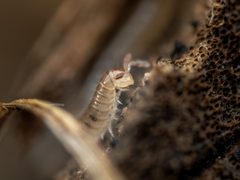
Greyish-brown body with dark spots along the lateral sides. Males reach 15 mm, females 12 mm. Possesses up to 58 body rings. Ocelli arranged in a single row paralleling the margin of the capsule. Metazonites bear 14–20 long setae on and dorsolateral margins. terminate in a funnel with fringed margins.
Habitat
Native occur in soil, under bark, and in dead wood of old trees, often on basic and calcareous bedrock; also recorded from caves and or mole nests in Europe. In Britain and Ireland, strongly associated with buildings and urban sites in northern England and Scotland; in southern areas occurs in leaf litter and under bark in deciduous woodland, plus sites such as waste ground, churchyards, and cultivated areas. Collected to 1,230 m elevation in the Alps.
Distribution
Native to the Atlantic zone of northwest Europe. and introduced extend across western, central, and northern Europe (southernmost France to northern Sweden), plus Madeira, the Azores, North America, and Tasmania. Widespread but uncommon in Britain and Ireland.
Seasonality
collected February–June and September–November in the British and Irish Isles. Postembryonic development studied over multiple years in a Finnish , suggesting extended developmental period.
Life Cycle
Postembryonic development occurs over multiple years, documented from a Finnish . activity bimodal in Britain and Ireland, with spring and autumn peaks.
Behavior
Strongly in northern parts of range, readily colonizing buildings and urban environments. Occasionally reported as agricultural pest.
Human Relevance
indicate to human-altered environments. Occasional minor agricultural pest status reported. sequenced as representative of Julida for comparative studies.
Similar Taxa
- Other BlaniulidaeShare general julid but differ in ocellar arrangement, setation patterns, and structure; precise identification requires examination of these characters.
- Other Choneiulus species-level characters overlap; distinction relies on fine details of and geographic distribution.
More Details
Genome
Published assembly from female collected in Abingdon, Oxfordshire, England: 626.52 Mb total length, 92.77% scaffolded into 14 chromosomal pseudomolecules.