
Lithobius forficatus
(Linnaeus, 1758)
brown centipede, garden centipede, stone centipede
Lithobius forficatus is a common stone in the Lithobiidae, native to Europe but introduced to North America, the Hawaiian Islands, and Colombia. reach 18–30 mm in length with 15 pairs of legs. The is freeze-tolerant in winter, , and an active of small . It is frequently found in gardens and woodland under stones and decaying wood.
Pronunciation
How to pronounce Lithobius forficatus: //lɪˈθoʊ.bi.əs fɔrˈfɪ.kætəs//
These audio files are automatically generated. While they are not always 100% accurate, they are a good starting point.
Identification
Distinguished from the striped Lithobius variegatus by absence of stripes on legs. Distinguished from other lithobiids by uniform chestnut brown coloration and combination of size range plus 15 leg pairs. When disturbed, exhibits extremely rapid escape to cover, more extreme than many other large lithobiid . Freeze in winter is a physiological trait not readily observable.
Images
Appearance
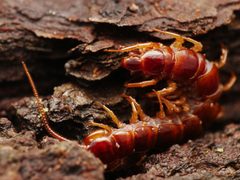
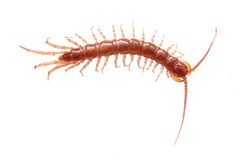
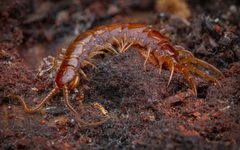
Elongated, flattened body 18–30 mm long and up to 4 mm broad. Uniform chestnut brown coloration without stripes on legs. possesses 15 pairs of legs, one pair per body segment. First pair of legs modified into venom-injecting forcipules (poison claws) beneath the . Simple (ocelli) present; no . long and multi-segmented.
Habitat
Upper soil layers, particularly under stones, rotting logs, and leaf litter. Found in woodland , gardens, and areas with anthropogenic disturbance. Requires moist microhabitats but occurs in drier woodland areas than L. variegatus. Overwinters under large logs that provide insulation.
Distribution
Native to Europe; introduced to North America, Hawaiian Islands, and Colombia (Bogotá area up to 2746 m elevation). Established in urban and disturbed in introduced range.
Seasonality
Active year-round with activity pattern. Freeze-tolerant during winter months, requiring inoculative freezing from external ice for survival. Summer individuals lack freeze . Oviposition occurs over extended period; sperm transfer primarily in spring.
Diet
of small including insects, spiders, slugs, worms, and flies. Has been observed to consume leaf litter material throughout the year, though the nutritional significance of this is unclear. Captures prey using venomous forcipules.
Life Cycle
Anamorphic development: hatches from with 7 pairs of legs, adds one leg pair per body segment at each . Reaches maximum 15 leg pairs at adulthood. Lifespan 5–6 years. Females lay eggs over extended period; males may seize eggs from females.
Behavior
Strictly , hiding under stones and leaf litter during daytime. Exhibits negative and positive thigmotaxis. Hunts using extremely sensitive tactile reception via base; oblivious to prey without direct contact. When exposed, executes extremely rapid escape to cover. Males have been reported to seize and consume from females.
Ecological Role
in soil and leaf litter , controlling of small . Serves as prey for larger predators. Contributes to nutrient cycling through consumption of leaf litter and on decomposer fauna.
Human Relevance
Common in gardens and urban environments where it provides of pest insects. Bite painful but not dangerous to humans, comparable to sting. Occasionally enters buildings; can be excluded by maintaining barriers between mulch and foundations and repairing door sweeps. Introduced in Colombia and elsewhere indicate human-mediated .
Similar Taxa
- Lithobius variegatusStriped with distinct stripes on legs, which L. forficatus lacks; occupies moister woodland
- Other Lithobius speciesMany European lithobiids require examination of leg striping, color pattern, and male genitalia for definitive identification
Misconceptions
Despite implying 100 legs, have only 30 legs (15 pairs). Not all are freeze-tolerant; summer L. forficatus individuals die if frozen, and winter survival requires specific conditions including inoculative freezing.
More Details
Freeze tolerance
Winter-adapted individuals survive freezing to −6°C only when inoculative freezing initiates from external ice. Thermal hysteresis proteins present in winter provide recrystallization inhibition, though concentrations are low and variable among individuals.
Neuroanatomy
comprises , forcipular ganglion, 15 leg ganglia (each with 8 nerve pairs), and terminal ganglion. Contains serially homologous histaminergic that represent individually identifiable neuron candidates for comparative studies.
Reproductive biology
involves giant primary with distinctive cytoplasmic fibers, Golgi elements, and . Acrosome formed from Golgi-derived material. Sperm transfer via .
Sources and further reading
- BugGuide
- Wikipedia
- GBIF taxonomy match
- iNaturalist taxon
- NCBI Taxonomy
- Pensoft Editorial Team | Blog - Part 84
- Life and death down under - Garden millipedes (Order Julida) and stone centipedes (Genus Lithobius — Bug of the Week
- SPERMATOGENESIS OF LITHOBIUS FORFICATUS
- Behaviour of the Common Centipede Lithobius forficatus
- First records of Lithobius (Lithobius) forficatus (Linnaeus, 1758) and Lithobius (Lithobius) obscurus Meinert, 1872 (Lithobiomorpha, Lithobiidae) introduced to Colombia
- Freeze tolerance adaptations in the centipede, Lithobius forficatus
- Bacterial diversity associated with the brown stone centipede, Lithobius forficatus (Chilopoda, Lithobiomorpha)
- A comparative analysis of the ventral nerve cord of Lithobius forficatus (Lithobiomorpha): morphology, neuroanatomy, and individually identifiable neurons
- THE FOOD AND REPRODUCTIVE CYCLES OF THE CENTIPEDES LITHOBIUS VARIEGATUS AND LITHOBIUS FORFICATUS IN A YORKSHIRE WOODLAND