
Pachymerium ferrugineum
Koch, 1835
Earth Centipede
Pachymerium ferrugineum is a geophilid exhibiting remarkable intraspecific variation in body size and leg number. display a latitudinal gradient in segment number, with southern individuals possessing more leg pairs than northern ones. The species occurs across a broad geographic range spanning Europe, Asia, and the Americas, including several oceanic islands. Its morphological plasticity has made it a subject of biogeographic and developmental studies.
Pronunciation
How to pronounce Pachymerium ferrugineum: //ˌpækɪˈmɪəriəm ˌfɛrəˈdʒɪniəm//
These audio files are automatically generated. While they are not always 100% accurate, they are a good starting point.
Identification
Distinguished from other Pachymerium and geophilid primarily by the extreme variability in leg pair number (41–69 pairs), which correlates with geographic origin. Northern European specimens have fewer leg pairs; southern and those on islands tend to have more. This clinal variation in segment number is a key diagnostic feature when combined with geographic data. Specific identification requires examination of and other genitalic characters not detailed in available sources.
Images
Appearance
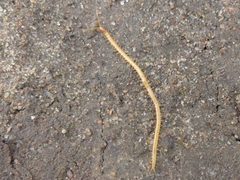
Elongated, worm-like body with variable dimensions. Short form reaches approximately 50 mm with 41–49 pairs of legs; long form reaches approximately 70 mm with 51 or more leg pairs. Maximum recorded leg pairs: 69 in Palestinian , minimum: 41 in Northern Europe. Coloration consistent with specific epithet ferrugineum (rust-colored). Body composed of numerous similar segments typical of Geophilomorpha.
Habitat
Soil-dwelling inhabiting terrestrial environments. Found in diverse substrates across its wide range, from temperate European forests to Mediterranean islands and subarctic Alaska. Specific microhabitat preferences (litter layer, soil depth, moisture requirements) are not documented in available sources.
Distribution
Palearctic distribution with transoceanic extensions. Native range includes Central Europe, Scandinavia, Iberian Peninsula, British Isles (implied by Bretagne records), Crete, Turkey, and Japan. Introduced or naturally occurring on Atlantic islands: Azores (São Miguel, Santa Maria), Canary Islands, and Cape Verde. Also recorded from Alaska, Mexico, Hawaii, and Easter Island (Chile). Shore of White Sea represents northernmost records.
Similar Taxa
- Other Geophilidae speciesDistinguished by the exceptional range of leg pair variation (41–69) and the documented latitudinal in segment number, which appears unique or at least unusually pronounced in this .
- Pachymerium speciesRequires detailed examination of genitalic ; the extreme intraspecific variability in this may cause confusion with if geographic context and full morphological series are not considered.
More Details
Intraspecific variation and biogeography
The has been extensively studied for its geographic variation in segment number. A study in the Biological Journal of the Linnean Society demonstrated more leg-bearing segments in southern versus northern North-west European . Aegean populations, particularly in the Cyclades, show variation potentially attributable to insular characteristics. This clinal variation represents a classic example of applied to segment number rather than body size in myriapods.
Taxonomic history
Originally described as Geophilus ferrugineus by Koch in 1835, later transferred to Pachymerium. The basionym reflects its historical placement in the broadly defined Geophilus.