
Arenophilus bipuncticeps
Wood, 1862
Northern Short-clawed Centipede
Arenophilus bipuncticeps is a of soil-dwelling in the Geophilidae, commonly known as the Northern Short-clawed Centipede. It belongs to the order Geophilomorpha, which comprises elongated, multi-legged centipedes adapted to burrowing in soil and leaf litter. The species was described by Wood in 1862 and is native to North America.
Pronunciation
How to pronounce Arenophilus bipuncticeps: //ˌærəˈnɒfɪləs baɪˌpʌŋkˈtiːsɛps//
These audio files are automatically generated. While they are not always 100% accurate, they are a good starting point.
Identification
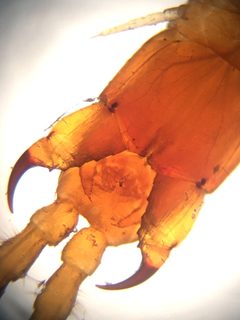
Distinguished from other Arenophilus by the two punctate markings on the (referenced in the specific epithet 'bipuncticeps'). Distinguished from other geophilomorph by family-level characters of Geophilidae. Differs from larger, more conspicuous (e.g., Scolopendridae) by smaller size, more numerous leg pairs, and shorter forcipules. Identification to species level requires examination of head , number of leg pairs, and other subtle morphological characters.
Images
Appearance
Elongated, cylindrical body with numerous segments bearing short legs—characteristic of Geophilomorpha. The specific epithet 'bipuncticeps' suggests two punctate (dot-like) markings on the . As a 'short-clawed' , the forcipules (venomous front legs) are relatively short compared to other centipede groups. Body coloration is likely pale to brownish, typical of soil-dwelling geophilomorphs.
Habitat
Soil-dwelling; inhabits terrestrial environments including soil, leaf litter, and decaying organic matter. Typical of geophilomorph , it requires moist microhabitats to prevent desiccation.
Distribution
Native to North America. Documented from the United States and Middle America (Mexico and Central America). Specific state or provincial records are limited in available sources.
Diet
Predatory on small soil-dwelling including springtails, mites, and other microarthropods.
Life Cycle
Development is anamorphic: juveniles hatch with fewer leg pairs than and add segments/leg pairs through successive until reaching the adult complement. Specific number of leg pairs and developmental stages not documented.
Behavior
and secretive; spends most of its life in soil and leaf litter. Moves through pre-existing crevices rather than excavating burrows. Likely slow-moving compared to surface-active .
Ecological Role
in soil ; contributes to regulation of microarthropod . Participates in nutrient cycling through consumption and processing of soil-dwelling prey.
Human Relevance
No documented medical or economic significance. Not known to bite humans; short forcipules and small size make it unlikely to penetrate human skin. Occasionally encountered by gardeners or in soil . Contributes to soil health as a natural of potential pest organisms.
Similar Taxa
- Other Arenophilus speciesShare -level characters; distinguished by markings, leg pair counts, and geographic distribution
- Geophilus spp.Same (Geophilidae) with similar body plan; distinguished by generic-level characters of structure and leg counts
- Scolopendridae (tropical centipedes)Superficially similar but much larger, with 21-23 leg pairs versus 30+ in Geophilomorpha, and longer, more prominent forcipules
More Details
Taxonomic Note
The Arenophilus is part of the diverse Geophilidae, one of the largest families of . The specific epithet 'bipuncticeps' is derived from Latin 'bi-' (two) + 'punctum' (point/dot) + '-ceps' (), referring to diagnostic head markings.
Observation Data
Only 15 observations recorded on iNaturalist as of source date, indicating the is underreported or genuinely uncommon in collections, likely due to its small size and subterranean habits.