
Ctenolepisma
Escherich, 1905
Species Guides
2- Ctenolepisma lineatum(Four-lined Silverfish)
- Ctenolepisma longicaudatum(gray silverfish)
Ctenolepisma is a of primitive wingless insects in the order Zygentoma, Lepismatidae. The genus comprises approximately 75 extant distributed nearly worldwide in warm regions, with some species occurring both indoors and outdoors while others are found exclusively in natural . Unlike the closely related silverfish (Lepisma saccharina) and firebrat (Thermobia domestica), many Ctenolepisma species are less dependent on human habitation. Australia lacks native species but introduced . The genus has undergone taxonomic revision, with ICZN Opinion 2427 (2018) establishing the neuter gender of Lepisma and related genera, resulting in species epithet changes such as Ctenolepisma longicaudatum (formerly longicaudata).
Pronunciation
How to pronounce Ctenolepisma: /ˌktɛnoʊləˈpɪzmə/
These audio files are automatically generated. While they are not always 100% accurate, they are a good starting point.
Identification
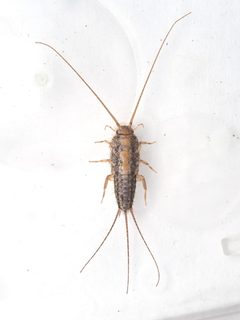
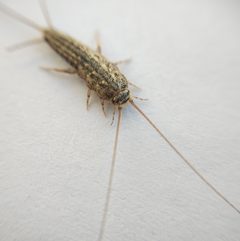
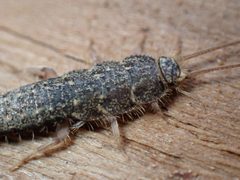
Distinguished from Lepisma by subtle morphological differences, including chaetotaxy (bristle arrangement) and patterns. Ctenolepisma lineata (Four-lined Silverfish) shows four dark longitudinal lines on the dorsum. Ctenolepisma longicaudatum is larger than typical silverfish. Accurate identification often requires microscopic examination; C. calvum (Ghost Silverfish) lacks pigmentation and is particularly difficult to detect. Males can be distinguished by the presence of production structures.
Images
Habitat
varies by : some are exclusively (indoor), found in buildings, museums, libraries, and storage facilities; others occur both indoors and outdoors in warm regions; some species are exclusively outdoor-dwelling. Synanthropic species thrive in modern building designs with stable temperatures. C. calvum appears restricted to buildings with unknown natural habitat. Climate change may enable expansion into outdoor environments in temperate regions.
Distribution
Nearly worldwide in warm regions. Native to most continental landmasses except Australia (which has only introduced ). Documented across Europe (including Switzerland, Germany, Austria, Estonia, Poland, Hungary, Russia, Ukraine), North America, Caribbean (Cuba, Trinidad and Tobago), South Asia (Sri Lanka, India), and other regions. C. longicaudatum is and expanding in northern Europe. C. calvum has spread to 18 European countries since its 2007 discovery in Germany.
Seasonality
Active year-round in indoor environments; outdoor activity patterns in warm regions not well documented. consistent across .
Diet
Feeds on , with particular preference for starchy materials. Documented consumption includes bookbinding paste, wallpaper adhesive, starch in clothing (especially silk and rayon), oatmeal, damp wheat flour, cereals, and other polysaccharide sources.
Life Cycle
Undergoes (ametabolous development). Young resemble but are not sexually mature. repeatedly to reach adulthood, then continues molting throughout life. Laboratory specimens have molted over 40 times in 2.5-year lifespans. Lifespan of at least two years under laboratory conditions documented.
Behavior
, hiding in crevices during daylight. Rapid escape running when startled, nearly matching speed. Males deposit and use silk strands from mouthpart glands to loosely restrain females, facilitating sperm transfer. Females lay singly or in small batches in cracks and crevices.
Ecological Role
Scavenger of detrital in built environments; may serve as prey for such as house centipedes and spiders in human dwellings. Role in natural poorly documented for most .
Human Relevance
Occasional pest in libraries, museums, warehouses, and storage facilities, particularly those lacking climate control. Damage to books, wallpaper, textiles, and stored food products. C. calvum identified as emerging museum pest in Central Europe. Generally nuisance-level rather than economically significant pest. occurs via packaging materials, paper, cardboard, and collection items.
Similar Taxa
- Lepisma saccharinaCommon silverfish; distinguished by patterns, body proportions, and preference (more strictly )
- Thermobia domesticaFirebrat; prefers warmer, drier conditions near heat sources; distinguished by thermal and selection
- Atelura formicariaNative European silverfish ally; myrmecophilous (-associated) rather than free-living in human structures
More Details
Nomenclatural history
ICZN Opinion 2427 (2018) ruled that Lepisma and with the same ending are neuter, not feminine, resulting in epithet changes (e.g., longicaudatum not longicaudata).
Invasion dynamics
C. longicaudatum and C. calvum show rapid European spread through human-mediated transport; monitoring via sticky traps documents establishment in museums and public buildings.
Sources and further reading
- BugGuide
- Wikipedia
- GBIF taxonomy match
- iNaturalist taxon
- NCBI Taxonomy
- Catalogue of Life
- Bug Eric: Silverfish and Firebrat
- Researchers Find Hundreds of Arthropod Species in U.S. Homes
- First record of <i>Ctenolepisma (Ctenolepisma) rothschildi</i> Silvestri, 1907 from Tripura and West Bengal, India
- The Distribution of Ctenolepisma urbana Slabaugh and Certain Other Lepismatidae
- Zygentoma of Switzerland: Faunistic contribution with first records of Ctenolepisma longicaudatum and new occurrences of Atelura formicaria
- Pheromone-based Arrestment Behavior in the Common Silverfish, Lepisma saccharina, and Giant Silverfish, Ctenolepisma longicaudata
- An update to the distribution of invasive Ctenolepisma longicaudatum Escherich in northern Europe, with an overview of other records of Estonian synanthropic bristletails (Insecta: Zygentoma)
- Identification and Spread of the Ghost Silverfish (Ctenolepisma calvum) among Museums and Homes in Europe