
Pycnopsyche
Banks, 1905
northern caddisflies
Species Guides
10- Pycnopsyche antica(northern caddisfly)
- Pycnopsyche circularis
- Pycnopsyche gentilis(caddisfly)
- Pycnopsyche guttifera(northern caddisfly)
- Pycnopsyche indiana(northern caddisfly)
- Pycnopsyche lepida(northern caddisfly)
- Pycnopsyche limbata(northern caddisfly)
- Pycnopsyche luculenta(northern caddisfly)
- Pycnopsyche scabripennis(giant red sedge)
Pycnopsyche is a of northern caddisflies comprising approximately 17 described . Larvae are aquatic inhabiting leaf packs in temperate streams, where they construct portable cases from leaf material. The genus exhibits temporal partitioning among sympatric species, with differences in case materials, preferences, and periods reducing .
Pronunciation
How to pronounce Pycnopsyche: /ˌpɪknoʊˈsaɪki/
These audio files are automatically generated. While they are not always 100% accurate, they are a good starting point.
Identification
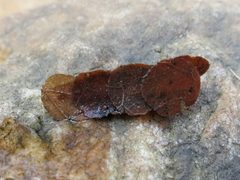
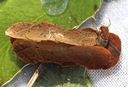
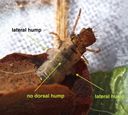
Larvae construct distinctive portable cases from leaf material, distinguishing them from mineral-case builders. -level identification requires examination of genitalia; P. scabripennis is notably larger ('giant red sedge'). Larvae of sympatric species may be distinguished by case material composition and microhabitat preference—P. lepida occupies faster, shallower water while P. guttifer prefers slower, deeper areas.
Images
Habitat
Small to medium streams and springbrooks in temperate regions; larvae specifically inhabit leaf packs and accumulations of allochthonous organic material. Microdistribution varies by : some occupy faster, shallower riffles while others occur in slower, deeper water.
Distribution
Northern North America; recorded from Michigan, Vermont, and eastern Canada. The is broadly distributed across temperate eastern North America with -specific ranges.
Seasonality
Larvae active year-round in aquatic with final instars observed February through August. and activity varies by ; P. scabripennis exhibits early and emergence, while P. gentilis and P. luculenta are contemporaneous with overlapping but temporally offset peak flight periods.
Diet
Larvae feed on leaf litter conditioned by aquatic hyphomycete fungi. For P. gentilis, fungal contributes 56% of assimilated nitrogen and 47% of assimilated carbon; early instars derive up to 100% of growth from fungal carbon while later instars obtain approximately 50% from fungi with remainder from detrital material modified by fungal .
Life Cycle
Aquatic larval stage occupies leaf pack ; final instar larvae observed February through August with occurring in stream. P. scabripennis exhibits rapid growth with early and , reducing temporal overlap with .
Behavior
Larvae construct portable cases from leaf material, with -specific preferences in case material composition. Larvae exhibit microhabitat segregation that reduces among sympatric species. males of different species arrive at light traps at different peak times when active on the same night, contributing to reproductive isolation. Marked individuals show measurable patterns within stream systems.
Ecological Role
in stream detrital ; processes leaf litter and mediates energy transfer to higher . Fungal consumption accelerates nutrient cycling. Case-building activity contributes to physical breakdown of organic matter. Coexisting partition resources temporally and spatially, maintaining diverse shredder .
Sources and further reading
- BugGuide
- Wikipedia
- GBIF taxonomy match
- iNaturalist taxon
- NCBI Taxonomy
- Catalogue of Life
- Factors Limiting the Microdistribution of Larvae of the Caddisflies Pycnopsyche lepida (Hagen) and Pycnopsyche guttifer (Walker) in a Michigan Stream (Trichoptera: Limnephilidae)
- Contribution of fungal biomass to the growth of the shredder, Pycnopsyche gentilis (Trichoptera: Limnephilidae)
- Larval Behavior and Dispersion of Pycnopsyche Luculenta (Betten) Demonstrated by a Unique Tagging Method (Limnephilidae: Trichoptera)
- TEMPORAL PATTERNS IN LIFE HISTORY AND FLIGHT BEHAVIOUR OF PYCNOPSYCHE GENTILIS, P. LUCULENTA, AND P. SCABRIPENNIS (TRICHOPTERA: LIMNEPHILIDAE)
- Case-Building Behavior, Persistence, and Emergence Success of <i>Pycnopsyche Guttifer</i> (Walker) (Trichoptera: Limnephilidae) in Laboratory and <i>in situ</i> Environments: Potential Trade-Offs of Material Preference