
Stenophylacini
Schmid, 1955
northern caddisflies
Genus Guides
4- Clostoeca
- Hydatophylax(northern caddisfly)
- Philocasca
- Pycnopsyche(northern caddisflies)
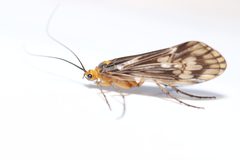
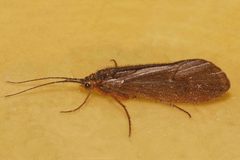
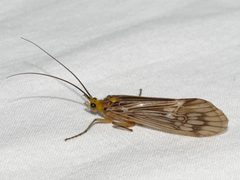
Stenophylacini is a tribe of caddisflies (Trichoptera) in the Limnephilidae, comprising at least 20 and approximately 190 described . The tribe includes the type genus Stenophylax and related genera such as Micropterna, Potamophylax, Mesophylax, and Allogamus. Several species within this tribe have been documented in subterranean , indicating ecological diversity across the group.
Pronunciation
How to pronounce Stenophylacini: /stɛnoʊˈfaɪləsɪnaɪ/
These audio files are automatically generated. While they are not always 100% accurate, they are a good starting point.
Identification
Larval identification relies on specific morphological characters including the presence or absence and structure of at lateral , the extent of spinule fields, and the number of posterolateral setae on abdominal dorsum IX. Some groups, such as Potamophylax goulandriorum with P. cingulatus, P. latipennis, and P. luctuosus, cannot be reliably separated by larval alone.
Images
Habitat
Primarily lotic and lentic freshwater . At least 13 across three (Stenophylax, Micropterna, Mesophylax) are regularly observed in subterranean environments, indicating significant cavernicolous within the tribe.
Distribution
Holarctic distribution with strong representation in the Palearctic region. Documented from the Hellenic western Balkan region (European Ecoregion 6), Eastern Aegean islands, Levant, Turkey, Cyprus, Bulgaria, Greece (including Crete and Karpathos), and Macedonia. The tribe is characterized as "northern caddisflies" in taxonomic literature.
More Details
Type genus
The type for Stenophylacini is Stenophylax F. Kolenati, 1848.
Cytogenetic research
Variation in indices has been studied in Stenophylacini, with chromosomal analysis conducted on member .
Sources and further reading
- BugGuide
- Wikipedia
- iNaturalist taxon
- NCBI Taxonomy
- Catalogue of Life
- Ecologie et reproduction chez les Trichoptères cavernicoles du groupe de Stenophylax (Limnephilidae, Stenophylacini)
- Ecology, case structure, larval morphology and chromosomes of the caddis-fly, allogamus auricollis (Pictet, 1834), with a discussion on the variation of recombination indices in the stenophylacini (Trichoptera, Integripalpia: Limnephilidae)
- The larvae of Micropterna coiffaiti Décamps 1963, Micropterna taurica Martynov 1917, and Potamophylax goulandriorum Malicky 1974 (Trichoptera: Limnephilidae), including a key to the hitherto known Stenophylacini larvae of the Hellenic western Balkan region