
Selenothrips rubrocinctus
(Giard, 1901)
redbanded thrips, cacao thrips, red-banded thrips
Selenothrips rubrocinctus is a small known as the redbanded thrips, recognized by the distinctive red banding on its dark body. It is a pest with a near pan-tropical distribution, first described from the West Indies though possibly originating in northern South America. The species is economically significant as a pest of cacao, mango, cashew, and various ornamental trees, causing leaf silvering, distortion, and fruit damage through sap-feeding. exhibit seasonal dynamics tied to plant water stress and nutritional status, with peaks typically occurring during dry seasons.
Pronunciation
How to pronounce Selenothrips rubrocinctus: //ˌsɛlɛnoʊˈθrɪps ˌruːbroʊˈsɪŋktəs//
These audio files are automatically generated. While they are not always 100% accurate, they are a good starting point.
Identification
distinguished from similar dark by the reddish coloration on the first three abdominal segments and anal segments; males are notably smaller and seldom encountered. Nymphs and pupae are readily identified by their distinctive yellow or pale orange color with vivid red bands on the first three abdominal segments and abdominal tip, contrasting sharply with the dark adult form. The combination of dark adults and brightly colored stages is diagnostic within the .
Images
Appearance
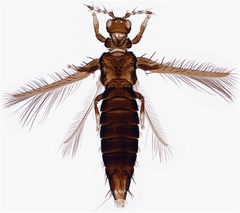
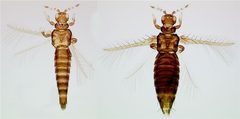
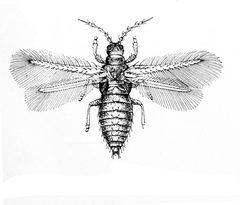
females are approximately 1.2 mm in length; males are slightly smaller and rarely observed. Body coloration is black or dark brown with a reddish tinge, most pronounced on the first three abdominal segments and the anal segments. Wings are dark. Nymphs and pupae are yellow or pale orange with vivid red coloration on the first three abdominal segments and the abdominal tip, providing striking contrast to the dark adults.
Habitat
Occurs on fruiting and ornamental trees in tropical and subtropical environments. In natural settings, are associated with plants experiencing water stress, which induces metabolic conditions favorable for establishment. Has been observed in urban ornamental plantings in Europe. Laboratory rearing successful on rose leaflets maintained on moistened filter paper substrate.
Distribution
Near pan-tropical distribution including North, Central, and South America (West Indies, Rica, Honduras, Panama, Brazil, British Guiana, Ecuador, Peru, Surinam, Venezuela), Africa (Congo, Fernando Po, Ghana, Ivory Coast, Nigeria, Principe, Republic of Congo, Sao Thomé, Sierra Leone, Tanganyika, Uganda, Zanzibar), southern Asia (China, Taiwan, India, Malaya, Philippines), and Australasia and Pacific Islands (Hawaii, Mariana Islands, New Caledonia, Papua New Guinea, Solomon Islands, Wallis Island). First field record in Europe from northern Italy on Liquidambar styraciflua and Carpinus betulus in urban areas.
Seasonality
increase during dry seasons, reaching peaks in April or May in Trinidad, then decline rapidly during wet seasons. Activity and breeding are closely tied to plant water stress and nutritional status rather than calendar date alone.
Diet
Feeds on plant sap by inserting mouthparts into the of young leaves, typically on the lower stomata-bearing surface. Feeding site selection influenced by leaf water content and α- concentration; prefers leaves with elevated amino acid levels associated with water stress. On cashew, feeds on mature leaves that have hardened but are not yet .
Host Associations
- Theobroma cacao - pestsignificant pest in the West Indies
- Mangifera indica - pestsignificant pest in the West Indies
- Anacardium occidentale - in Trinidad and Tanganyika; studied extensively
- Persea americana - attacked in certain
- Psidium guajava - attacked in certain
- Liquidambar styraciflua - first European record, northern Italy
- Carpinus betulus - first European record, northern Italy
- Rosa - laboratory successful laboratory rearing on rose leaflets
Life Cycle
are deposited individually on the underside of leaves and covered with a fluid droplet that hardens into a protective black disc. Incubation approximately 4 days. Nymphal stage comprises two feeding instars lasting about 9 days total, followed by two non-feeding stages: pre-pupa and pupa. Complete takes approximately 3 weeks. Multiple per year. females live about one month and produce up to 50 eggs by ; males are rarely observed suggesting primarily parthenogenetic .
Behavior
Feeds preferentially on the lower stomata-bearing surface of leaves under normal conditions; preference weakens in very humid atmospheres. Avoids exposure to undue heat and dryness, migrating to shaded leaf surfaces when lower surfaces are exposed to insolation by leaf . Distribution on leaves follows patterns that develop in fixed sequence under normal water conditions, but becomes random on leaves under abnormal water stress. Colonizes leaf areas with elevated α- concentrations, particularly associated with injury or water stress.
Ecological Role
Herbivore that induces localized metabolic changes in plant tissue through feeding. establishment obligately dependent on prior metabolic derangement in host leaves, specifically retardation of protein synthesis resulting from environmental stress. May serve as indicator of host plant physiological stress status.
Human Relevance
Economic pest of cacao, mango, and cashew production in tropical regions, causing leaf silvering, browning, crinkling, and distortion; heavy cause defoliation and tree denudation. Fruit damage includes russet appearance, cracking, and subsequent decay. Subject of laboratory rearing protocols for biological study. First European records suggest potential for range expansion with climate change or horticultural trade.
Similar Taxa
- Other Selenothrips speciesDark coloration with reddish markings shared within ; S. rubrocinctus distinguished by specific abdominal banding pattern and known distribution
- Other dark ThripidaeSmall dark are numerous; S. rubrocinctus identified by combination of size, abdominal red banding, and distinctive yellow-orange nymphs with red markings
Sources and further reading
- BugGuide
- Wikipedia
- GBIF taxonomy match
- iNaturalist taxon
- NCBI Taxonomy
- Catalogue of Life
- Selenothrips rubrocinctus . [Distribution map].
- Breeding technique of Selenothrips rubrocinctus (Giard, 1901) (Thysanoptera: Thripidae) on roses leaflets
- Selenothrips Rubrocinctus(Giard) and the Floral Biology of Cashew in Tanganyika
- First Field Record of the Tropical Red-Banded Thrips Selenothrips rubrocinctus (Thripidae: Panchaetothripinae) in Europe
- Nutritional factors associated with seasonal population increase of cacao thrips,Selenothrips rubrocinctus(Giard) (Thysanoptera), on cashew, Anacardium occidentale
- The influence of environmental stress on the cacao tree in predetermining the feeding sites of cacao thrips, Selenothrips rubrocinctus (Giard), on leaves and pods