
Aeolothrips kuwanaii
Moulton, 1907
banded thrips
Aeolothrips kuwanaii is a of predatory thrips in the Aeolothripidae, described by Moulton in 1907. It is native to western North America and is characterized by distinctive black-and-white banded wings. As a member of the Aeolothripidae, it is predatory on other small arthropods. The species has been recorded from Arizona, Nevada, Oregon, and Canada.
Pronunciation
How to pronounce Aeolothrips kuwanaii: /eɪˌɑːloʊˈθrɪps ˌkuːwəˈnaɪi/
These audio files are automatically generated. While they are not always 100% accurate, they are a good starting point.
Identification
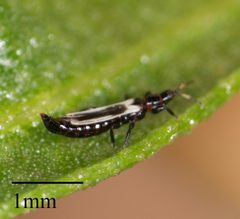
The distinctive black-and-white banded wing pattern distinguishes Aeolothrips kuwanaii from most other thrips . It can be separated from the similar A. fasciatus by wing banding: A. kuwanaii has only humeral and post- white bands, while A. fasciatus has humeral, median, and bands. Franklinothrips vespiformis, another predatory thrips, lacks the banded pattern entirely. Identification to species level requires examination of wing banding pattern and may require reference to original description or keys.
Images
Appearance
have long, narrow forewings with distinctive alternating black and white bands across the wing surface. The body is minute, approximately 1–2 mm in length. Wings possess characteristic fringed margins (setae along the edges), typical of Thysanoptera. The banding pattern consists of humeral (basal) and post- white bands on a dark background, differing from the three-band pattern (humeral, median, and ) seen in some such as A. fasciatus.
Distribution
Western North America: recorded from Arizona, Nevada, and Oregon in the United States, and from Canada. The appears to have a distribution centered in arid and semi-arid western regions.
Diet
Predatory on other small arthropods, including other thrips and mites. Members of Aeolothripidae are known to consume wind-blown pollen as supplementary food.
Ecological Role
of pest thrips such as Frankliniella occidentalis and Thrips tabaci, and of mites. Has been studied for potential use in in agricultural systems.
Human Relevance
Investigated as a agent in agricultural contexts due to its on pest thrips and mites. No documented negative impacts on humans.
Similar Taxa
- Aeolothrips fasciatusSimilar banded wing pattern, but differs in having three white bands (humeral, , and ) versus two bands (humeral and post-median) in A. kuwanaii
- Franklinothrips vespiformisAnother predatory thrips in related Franklinothripidae, but lacks banded wing pattern entirely
More Details
Taxonomic authority
Described by Dudley Moulton in 1907. The specific epithet 'kuwanaii' honors Dr. Shinkichi Kuwana, a Japanese entomologist who worked extensively on Thysanoptera.
Etymology note
The prefix 'Aeolo-' in Aeolothrips and Aeolothripidae refers to Aeolus, the Roman king of the winds, alluding to the wind-dispersed nature of winged thrips.