
Cerastipsocus venosus
(Burmeister, 1839)
Tree Cattle, Common Barklouse
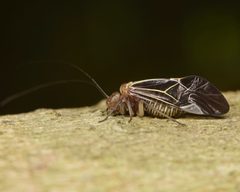
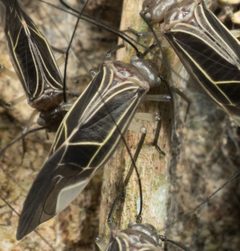
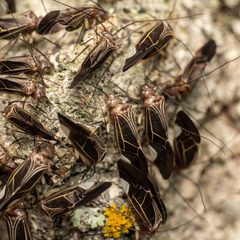
Cerastipsocus venosus is a widespread barklouse in the Psocidae, commonly known as "Tree Cattle" due to the herding of its nymphs. It occurs across North America, Central America, and the Caribbean. Both nymphs and aggregate on tree bark and foliage, where they feed on lichens and other organic matter. The species is harmless to plants and plays a role in nutrient cycling.
Pronunciation
How to pronounce Cerastipsocus venosus: /sɛrəˌstɪpsoʊkəs vɪˈnoʊsəs/
These audio files are automatically generated. While they are not always 100% accurate, they are a good starting point.
Identification
Distinguished from aphids by large with chewing mouthparts (aphids have small heads with tubular sucking mouthparts). Nymphs distinguished by presence of wing buds. of nymphs move as tightly packed herds, a not seen in aphids. Silk webbing and jelly-bean shaped beneath leaves are characteristic. Wing venation patterns aid -level identification.
Images
Appearance
have fully developed wings with distinct venation patterns. Nymphs are wingless with visible wing buds developing on the . Body is small and soft-bodied. Coloration is variable and sometimes brightly patterned. Large bears chewing mouthparts. are jelly-bean shaped and deposited beneath silken webs.
Habitat
Found on bark and foliage of trees and shrubs. Often associated with plants supporting lichen and growth, such as hollies. Cool, humid conditions with morning fog and afternoon sunlight favor . Sometimes occurs on plants with soft , where may provide additional food sources.
Distribution
North America (USA, Canada), Central America (Mexico), and Caribbean (Cuba). Present throughout the Caribbean region and Middle America.
Seasonality
Active during periods of cool, humid weather. observed in Maryland during late summer and early autumn. Year-round activity likely in tropical and subtropical portions of range.
Diet
Feeds on lichens, , and other organic detritus. Has been observed consuming associated with honeydew-producing insects.
Host Associations
- Ilex (holly) - frequent substratecommonly found beneath broad evergreen leaves
- Crataegus (hawthorn) - frequent substratedense silk veils observed on branches
- soft scales (Coccoidea) - indirect associationhoneydew and resulting may serve as food source
Life Cycle
are deposited beneath silken webs on undersides of leaves. Nymphs develop through multiple instars with visible wing buds in later stages. Winged emerge after final . Nymphs aggregate in herds during development.
Behavior
Nymphs move in tightly packed herds. and nymphs form large on bark and foliage. Produces silk from specialized mouth glands to create protective webs over and communal living spaces. Dense can generate silk shrouds covering entire branches and trunks. Adults are easily disturbed by contact.
Ecological Role
Contributes to decomposition and nutrient cycling by consuming lichens, , and organic detritus. Serves as a member of natural recycling on vegetation. Does not harm living plant tissue.
Human Relevance
Harmless to plants and not considered a pest in natural settings. May be mistaken for aphids or other plant pests during inspections. Provides educational value as an example of beneficial decomposer insects. Occasionally noticed by homeowners on ornamental trees and shrubs.
Similar Taxa
- aphids (Aphidoidea)similar and on plants; distinguished by size, mouthpart type, and presence of wing buds in nymphs
- other Psocidaesimilar and ; distinguished by wing venation patterns and geographic distribution
Misconceptions
Often mistaken for plant pests due to . Not a booklouse despite relationship—booklice occur in stored products and feed on starch-based materials, while this is exclusively associated with outdoor vegetation.
More Details
Silk Production
Produces silk from specialized glands in the mouth, used to create webs that protect and shelter .
Population Density
Capable of reaching high densities that produce visible silk shrouds covering branches, as documented on hawthorn at an interstate rest stop.