
Timema bartmani
Vickery & Sandoval, 1997
Bartman's Timema
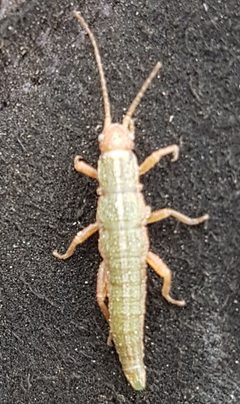
Timema bartmani is a of in the Timematidae, a group of small, wingless walkingsticks native to western North America. The Timema is notable for being the earliest-diverging lineage of extant stick insects and for its role in evolutionary studies of speciation and camouflage. T. bartmani was described in 1997 and is known from California. Like other Timema species, it exhibits cryptic coloration for camouflage against plants.
Pronunciation
How to pronounce Timema bartmani: /tɪˈmiːmə ˈbɑrtməni/
These audio files are automatically generated. While they are not always 100% accurate, they are a good starting point.
Images
Distribution
California, United States; North America. Distribution records indicate presence in California specifically.
More Details
Taxonomic Note
Timema bartmani was described by Vickery & Sandoval in 1997. The Timema is the sole extant member of the Timematidae and represents the earliest-branching lineage of stick insects (), making it significant for understanding the evolutionary history of the order.
Research Context
While T. bartmani itself has not been the focus of major research studies, the Timema has become an important model system for studying ecological speciation, , and the genetics of camouflage. Studies on related such as T. cristinae have examined how color and plant associations influence and speciation processes. These findings may have relevance for understanding evolutionary dynamics in T. bartmani and other Timema species.