
Phymonotus jacintotopos
Lightfoot, Weissman & Ueshima, 2011
San Jacinto shieldback
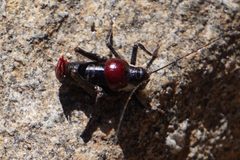
Phymonotus jacintotopos is a rare, shield-backed katydid to the San Jacinto Mountains of southern California. It is distinguished by an unusually enlarged dome-like pronotum, distinctive red-and-black coloration, and a unique calling song. The is considered a Pleistocene relic, restricted to isolated high-elevation conifer forests. It belongs to the tribe Nedubini, whose members have a Gondwanan distribution.
Pronunciation
How to pronounce Phymonotus jacintotopos: /ˌfaɪmoʊˈnoʊtəs ˌjæsɪntoʊˈtoʊpoʊs/
These audio files are automatically generated. While they are not always 100% accurate, they are a good starting point.
Identification
The enlarged dome-like pronotum is the most immediately visible diagnostic feature, unlike the flatter pronota of relatives Agalothorax and Neduba. The red-and-black color pattern distinguishes it from all similar katydids in the region. Males produce a distinctive calling song. Genitalia examination reveals unique titillator structures: and lobes and dorsal not found in related .
Images
Appearance
Medium-sized shield-backed katydid with an unusually enlarged, dome-like pronotum that extends over the . Distinctive red-and-black coloration not found in similar katydids. Seven additional distinctive morphological features separate it from relatives, including specialized structures of the male genitalia: and lobes of the titillators, and dorsal of the titillators.
Habitat
Geographically isolated high-elevation conifer forests of the San Jacinto Mountains. Occupies montane forest environments above the elevational range of its nearest relatives.
Distribution
to the San Jacinto Mountains of southern California, USA. Restricted to this isolated mountain range; no known elsewhere.
Behavior
Males produce a distinctive calling song. Males have been observed to produce thoracic glandular secretions that may be offered to mating females, suggesting possible courtship feeding .
Similar Taxa
- AgalothoraxOccurs in lower elevation environments throughout the surrounding region; lacks the enlarged dome-like pronotum and red-and-black coloration of Phymonotus.
- NedubaOccurs in lower elevation environments throughout the surrounding region; lacks the enlarged dome-like pronotum and red-and-black coloration of Phymonotus.
More Details
Evolutionary significance
Considered a Pleistocene relic , persisting in isolated high-elevation refugia while climate change restricted it to current range. The tribe Nedubini has a Gondwanan distribution with additional taxa in Australia and South America; western North American members apparently result from a South American event.
Taxonomic novelty
Description of Phymonotus in 2011 established new diagnostic characters for : and lobes of the titillators, and dorsal of the titillators.