
Conocephalus cinereus
Thunberg, 1815
Caribbean Meadow Katydid
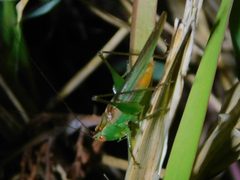
Conocephalus cinereus is a of meadow katydid in the Tettigoniidae, commonly known as the Caribbean Meadow Katydid. It belongs to the Conocephalinae, which includes abundant orthopterans in eastern North America and adjacent regions. As with other Conocephalus species, it possesses the characteristic long, thread-like that distinguish katydids from true grasshoppers. The species has been documented across the Caribbean region and parts of Central and North America.

Pronunciation
How to pronounce Conocephalus cinereus: /koʊˌnoʊˈsɛfələs sɪˈnɪəriəs/
These audio files are automatically generated. While they are not always 100% accurate, they are a good starting point.
Identification
Members of the Conocephalus can be distinguished from the larger conehead katydids in the genus Neoconocephalus by their smaller size. Females possess a prominent sword-like ovipositor at the rear of the , used for -laying in vegetation or soil. Males lack this structure. Like other katydids, Conocephalus cinereus has longer than its body, distinguishing it from grasshoppers which have short, stubby antennae. The forewings bear a file and scraper structure used for stridulation.
Images
Habitat
Meadow katydids in the Conocephalinae, to which this belongs, are typically found in tall grass including wetlands, lush meadows, and prairies.
Distribution
Documented from Colombia, Rica, Cuba, Florida (USA), and Guatemala. The "Caribbean Meadow Katydid" reflects its primary distribution in Caribbean regions.
Diet
As a member of the Conocephalinae, Conocephalus cinereus is likely . Related meadow katydids feed on grass seeds, foliage, flowers, and forbs, with some known to consume other insects opportunistically, particularly injured individuals such as leafhoppers and planthoppers.
Similar Taxa
- Conocephalus brevipennisBoth are meadow katydids in the same with short wings; C. brevipennis is distinguished by its specific wing length and song pattern of buzzes and ticks with short pauses
- Conocephalus fuscusBoth share the Conocephalus and possess prominent ovipositors; C. fuscus (Long-winged Conehead) has notably longer wings and is expanding its range in Europe
- Neoconocephalus speciesBoth are conehead katydids in the same ; Neoconocephalus are substantially larger, with some exceeding 7 cm in length, and are more robust
Sources and further reading
- BugGuide
- GBIF taxonomy match
- iNaturalist taxon
- Catalogue of Life
- Species Records and Accounts
- Minstrels of the meadow: Short-winged meadow katydid, Conocephalus brevipennis — Bug of the Week
- The Changing Distributions of our Grasshoppers, Crickets and Relatives - Buglife Blog - Buglife
- Bug Eric: Orthoptera Thursday: The Katydid's Menu
- What’s the difference between a cricket and a grasshopper? - Buglife Blog - Buglife
- Bug Eric: Wasp Wednesday: Great Golden Digger