
Ceuthophilus stygius
(Scudder, 1861)
Kentucky cave cricket, cave camel cricket, Stygian Cave Cricket
Ceuthophilus stygius is a camel cricket in the Rhaphidophoridae, commonly known as the Kentucky cave cricket or Stygian Cave Cricket. It is native to North America, with records from the southeastern United States and Indiana. As a member of the Ceuthophilus, it shares traits with other cave crickets including elongated , powerful jumping legs, and to dark, damp environments. The has been studied for its metabolic and water economy physiology in relation to body size and temperature.
Pronunciation
How to pronounce Ceuthophilus stygius: /ˌsuːˈθɒfɪləs ˈstɪdʒiəs/
These audio files are automatically generated. While they are not always 100% accurate, they are a good starting point.
Identification
Distinguished from true grasshoppers (Acrididae) by absence of wings, extremely long (longer than body), and humpbacked profile. Separated from Asian camel crickets (Diestrammena spp.) by native status and subtle morphological differences; precise identification requires examination of genitalia or expert determination. Distinguished from other Ceuthophilus by geographic range and subtle structural features.
Images
Appearance
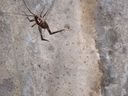
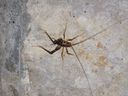
Wingless with a humpbacked (camel-like) body profile. Possesses extraordinarily long bearing sensory structures for navigation in darkness. Has long, powerful hind legs adapted for jumping. Body form typical of cave crickets in Ceuthophilus.
Habitat
Dark, damp environments including caves, deep woodlands, tool sheds, damp wood piles, and cool shaded areas near building foundations. In human-modified environments, found in basements, garages, and crawl spaces with high humidity and low light levels.
Distribution
North America; specifically recorded from the southeastern United States and Indiana. Native range appears centered in the eastern and central United States.
Seasonality
Home invasions occur in late summer and early autumn. Activity year-round in suitable cave .
Diet
Scavenger consuming decaying organic matter including leaves, roots, and fruits. Also feeds on rotting remains of other insects, including conspecifics.
Behavior
Exhibits thigmotaxis (traveling with body contact against walls). Capable of (voluntary leg detachment) when threatened by to facilitate escape. Powerful jumping ability allows leaps exceeding ten times body height. activity pattern in dark .
Ecological Role
Decomposer and scavenger in cave and forest floor . Contributes to nutrient cycling through consumption of decaying organic matter.
Human Relevance
Occasional household pest entering basements, garages, and crawl spaces. May nibble stored fabrics and leave fecal stains on wood and tools in sheds. Can be captured and relocated outdoors; used as fish by some anglers. Managed by reducing humidity, sealing foundation cracks, and removing vegetation near buildings.
Similar Taxa
- Diestrammena spp. (Asian camel crickets)Introduced competitors that have displaced native Ceuthophilus in many residential settings; distinguished by non-native status and subtle morphological differences
- Acrididae (true grasshoppers)May be confused due to '' and jumping ability; distinguished by short , presence of wings in most , and non-humpbacked body form
- Other Ceuthophilus speciesRequire detailed examination for precise identification; C. stygius distinguished by geographic distribution centered in Kentucky and surrounding regions
More Details
Physiological Ecology
Subject of study on metabolism and water economies related to body size and temperature, indicating adaptations to stable cave environments.
Sources and further reading
- BugGuide
- Wikipedia
- GBIF taxonomy match
- iNaturalist taxon
- NCBI Taxonomy
- Grasshoppers of Colorado
- Grasshoppers of Colorado
- Grasshoppers of Colorado
- Grasshopper Collections and Survey
- Five-legged cricket in the bathtub: Ceuthophilus spp. (American camel crickets) and Diestrammena spp. (Asian camel crickets) — Bug of the Week
- Move over American camel crickets, Asian camel crickets are in town: Ceuthophilus sp. (American camel crickets) and Diestrammena sp. (Asian camel crickets) — Bug of the Week
- Biology of cave crickets, Hadenoecus subterraneus, and camel crickets, Ceuthophilus stygius (Insecta: Orthoptera): Metabolism and water economies related to size and temperature