
Mohavacris
Rehn, 1948
desert long-horned grasshopper
Species Guides
1- Mohavacris timberlakei(Timberlake's Desert Long-horned Grasshopper)
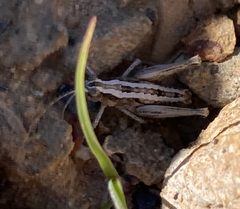
Mohavacris is a of grasshoppers in the Tanaoceridae, containing a single described , M. timberlakei. The genus is to desert regions of California and belongs to a small family of long-horned grasshoppers adapted to arid environments. Members of this family are characterized by their elongated and habits, distinguishing them from typical short-horned grasshoppers.
Pronunciation
How to pronounce Mohavacris: /moʊˈhævəkrɪs/
These audio files are automatically generated. While they are not always 100% accurate, they are a good starting point.
Identification
Distinguished from other Tanaoceridae by geographic restriction to the Mojave Desert region. The single M. timberlakei can be identified by its association with this name. -level traits include longer than the body, a feature separating Tanaoceridae from the more common Acrididae (short-horned grasshoppers).
Images
Habitat
Desert environments, specifically the Mojave Desert of California. Associated with arid, sandy or rocky desert substrates.
Distribution
Known from California, USA, specifically within the Mojave Desert region. GBIF records confirm distribution limited to this state.
Behavior
activity pattern has been documented for the Tanaoceridae; this trait is likely present in Mohavacris given family membership, though direct observation is limited.
Similar Taxa
- TanaocerusOther in Tanaoceridae; both share the long-horned grasshopper and habits, but Tanaocerus has broader distribution across southwestern US and Mexico
- Acrididae (short-horned grasshoppers)Superficially similar grasshoppers but distinguished by short (shorter than body), activity, and much greater
More Details
Taxonomic status
with single described M. timberlakei. The genus was established by Rehn in 1948.
Family characteristics
Tanaoceridae is a small of grasshoppers containing only two (Mohavacris and Tanaocerus) and approximately six total. These are among the few grasshoppers, with elongated adapted for sensory perception in darkness.