
Tanaoceridae
Rehn, 1948
desert long-horned grasshoppers
Genus Guides
2- Mohavacris(desert long-horned grasshopper)
- Tanaocerus(desert long-horned grasshoppers)
Tanaoceridae is a small of grasshoppers comprising two , Mohavacris and Tanaocerus. These insects are notable for their exceptionally long, thread-like that equal or exceed body length, a trait unusual among Caelifera that can cause confusion with crickets (Ensifera). They are , winter-active insects of arid regions, with (wingless) bodies and cryptic coloration adapted to desert environments.
Pronunciation
How to pronounce Tanaoceridae: /ˌtænəʊˈsɛrɪdiː/
These audio files are automatically generated. While they are not always 100% accurate, they are a good starting point.
Identification
Distinguished from other Caelifera by length equal to or exceeding body length, resembling Ensifera. The short, thick basal antennal segments combined with long, thin segments is diagnostic. Winglessness and /winter activity pattern further separate them from most . Mohavacris are bark-mimics on Artemisia shrubs; Tanaocerus species occur both on shrubs and ground.
Images
Appearance
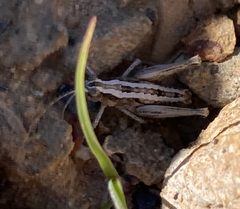
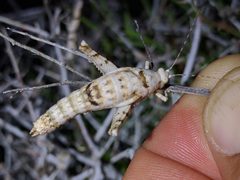
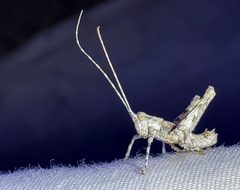
Slender to medium-sized grasshoppers with powerful jumping hind legs. Grey-spotted coloration providing camouflage. thin and at least as long as the body; the two innermost joints are short and thick, with remaining joints long and thin. round and protruding. small with collared pronotum. Wings absent ().
Habitat
Arid and semi-arid regions, specifically dry areas of the southwestern United States and northwestern Mexico. Associated with desert scrub vegetation, particularly wormwood shrubs (Artemisia spp., 'sagebrush') for Mohavacris; Tanaocerus occupies both shrubs and ground substrates.
Distribution
Southwestern North America: California, Nevada (United States), and northwestern Mexico.
Seasonality
Active during winter months when temperatures are relatively cool; activity pattern.
Host Associations
- Artemisia spp. - plantMohavacris timberlakei found on wormwood shrubs where camouflaged as bark
Life Cycle
probably laid in ground; hatching occurs in autumn.
Behavior
activity; winter-active when temperatures are cool. Mohavacris remain motionless on shrubs, relying on bark-mimicry camouflage. Both possess powerful jumping ability despite small size.
Ecological Role
Herbivorous component of desert ; prey base for .
Similar Taxa
- Ensifera (crickets/katydids)Similar long , but distinguished by antennal segment structure, jumping leg , and other Caelifera characteristics
- Other Caelifera familiesTanaoceridae uniquely combines long with aptery, /winter activity, and specific antennal segment proportions
More Details
Taxonomic position
Tanaoceridae is the sole in the superfamily , reflecting its isolated phylogenetic position within Caelifera.
Genera
contains two : Mohavacris Rehn, 1948 and Tanaocerus Bruner, 1906 (type Tanaocerus koebelei).