
Trimerotropis pallidipennis
(Burmeister)
pallidwinged grasshopper
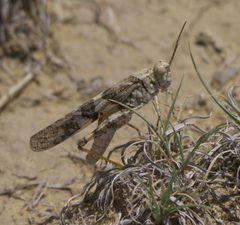
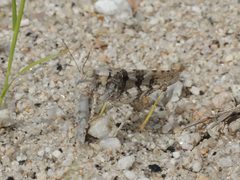
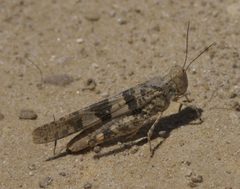
The pallidwinged grasshopper is a moderately-sized bandwinged with the most extensive distribution of any bandwinged grasshopper in the New World, ranging from southwestern Canada to Argentina. It inhabits desert and semidesert environments where undergo sporadic irruptions that can cause significant agricultural damage. The possesses strong capabilities and is known for swarming attracted to artificial lights. are typically brief, lasting one to two years, and are associated with above-normal rainfall that promotes survival and nymphal development.
Pronunciation
How to pronounce Trimerotropis pallidipennis: /ˈtraɪmɛrəʊˌtrɒpɪs pælɪˈdɪpɛnɪs/
These audio files are automatically generated. While they are not always 100% accurate, they are a good starting point.
Identification
Distinguished from other Trimerotropis by combination of: two transverse dark bands on tegmen crossing entire width; hindwing with narrow black band at center (not broad as in some ), white to pale yellow disk, and transparent apex; pronotal carina incised twice with straight edge lacking tooth; inner hind black with two yellow bars; yellow hind tibia. Nymphs identifiable by triangular foveolae, pronotal carina structure, and hindleg color pattern with black bars on pale tan ground in later instars.
Images
Habitat
Primary are deserts and semideserts of western North America, characterized by shrubs, forbs, and grasses with preponderance of bare ground used for basking and resting. Also occurs in sagebrush habitats at higher elevations (to 1,746 ft in Colorado) and weedy urban lots. Requires bare soil for oviposition and basking.
Distribution
Most widely distributed bandwinged in the New World; ranges from southwestern Canada through western United States to Argentina. In North America, occurs from southern British Columbia and Alberta south through all western states to Mexico. Documented in Wyoming, Colorado, Utah, Arizona, New Mexico, California, Idaho, Nevada, and Texas. Accidentally introduced to Hawaii (Oahu) in 1966, where it persisted through 1968.
Seasonality
Hatching begins in late February in south-central Arizona, late April in Utah, and early June in Colorado and Wyoming. appear mid-April in southern Arizona, early June in northern states. One per year in northern range; two or more generations possible in southern Arizona with favorable moisture. Second generation hatching in early June in south-central Arizona.
Diet
, feeding on variety of forbs and grasses with diet shifting based on availability and quality. Early spring diet dominated by grasses including downy brome (Bromus tectorum) and needle grama (Bouteloua aristidoides). Later switches to green grasses and forbs when annuals desiccate. Documented food plants include: downy brome, crested wheatgrass, thickspike wheatgrass, Sandberg bluegrass, blue grama, milkvetch, western salsify, big sagebrush, hoary aster, Greene rabbitbrush, gray rabbitbrush, Cryptantha sp., Solarium sp., Iva sp., Allionia incarnata, and Franseria deltoidea. Laboratory preferences include dandelion, kochia, downy brome, crested wheatgrass, and needle-and-thread. Crop contents occasionally contain parts, fungi, and pollen.
Life Cycle
Overwinters as in soil pods at approximately 1 inch depth. Eggs enter shortly after laying; development resumes with moisture and warmth. Under laboratory conditions (82-104°F), eggs hatch in 13-21 days without diapause. Nymphal period 31-60 days depending on temperature: 50 days at 70-84°F, 31-33 days at 81-101°F. Females have five or six instars, males usually five. live 67-80+ days. Females lay curved pods 1 inch long, 1/8 inch diameter, averaging 34 eggs per pod; maximum recorded 27 pods and 955 eggs per female. Preoviposition period averages 43 days (minimum 26 days).
Behavior
activity with basking on bare ground. Strong capabilities with flushed individuals flying 2-3 feet high, often exceeding 100 feet. Extended flight documented: one male circled for 17 minutes, swarms reported at 3,000-5,000 feet altitude. swarming to artificial lights during . (snapping sounds from hindwings) by males during flight initiates pair formation. Courtship involves stridulation producing trilling sounds, with 1-8 trills in quick . Marked individuals have been recovered up to 27 feet per day average displacement; low recapture rates (25%) indicate substantial by flight.
Ecological Role
Herbivore in desert and semidesert ; irruptions can substantially reduce plant . Serves as prey for various vertebrate and . and nymphs vulnerable to desiccation, making rainfall a critical population-limiting factor. populations may compete with other herbivores for forage resources.
Human Relevance
Significant agricultural pest during . Historical damage in Arizona (1958, 1998), California, New Mexico, and Utah. Crops damaged include wheat, cotton, carrots, sugarbeets, barley, milo, corn, safflower, and grapes. Defoliation and -cutting in small grains; seedling consumption to ground level in cotton, requiring replanting. Swarms attracted to city lights create traffic hazards from crushed grasshoppers on roads. Six outbreaks recorded in Arizona 1952-1980, typically one year duration (maximum two years). Managed with and cultural practices during outbreaks.
Similar Taxa
- Trimerotropis cyaneipennisShares bandwinged pattern but has blue or greenish hindwing disk rather than white to pale yellow
- Trimerotropis cinctaSimilar size and but differs in pronotal carina structure and hindwing band width
- Xanthippus corallipesOccurs in similar but has different hindwing coloration and pronotal structure; distinguished by coral-pink or yellow hindwing disk with different banding pattern
- Trachyrhachys kiowaPrevious in sequence, smaller with different wing venation and banding pattern
More Details
Population Dynamics
associated with above-normal, well-distributed rainfall during preceding fall, winter, and early spring. Ample moisture provides favorable soil conditions for and nutritious food plants for nymphs. between outbreaks rare in desert , with 3-4 year intervals typical. Outbreaks brief due to starvation of urban swarms and treatment of crop invasions.
Weight Variation
Body weight varies substantially with conditions. Sonoran Desert males average 268 mg versus 175 mg in Colorado sagebrush; females 565 mg versus 429 mg respectively. This plasticity reflects environmental resource availability.
Hawaiian Introduction
Only known successful long-distance : discovered September 7, 1966 at Ewa, Oahu, Hawaii, likely transported by wind from western North America. persisted through 1968 but no permanent establishment confirmed.