
Spharagemon bolli
Scudder, 1875
Boll's Grasshopper, Boll's Locust
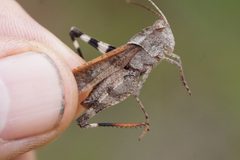
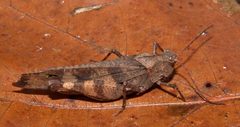
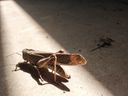
Spharagemon bolli is a of band-winged grasshopper in the Acrididae, commonly known as Boll's or Boll's Locust. It is characterized by cryptic coloration that provides camouflage in its preferred dry, rocky . The species has been documented in xeric igneous glades and surrounding dry woodlands, where its coloration makes it difficult to relocate after jumping. It is one of several Spharagemon species found in North America.
Pronunciation
How to pronounce Spharagemon bolli: /sfəˈrædʒəmɒn ˈbɒlaɪ/
These audio files are automatically generated. While they are not always 100% accurate, they are a good starting point.
Identification
Spharagemon bolli possesses cryptic coloration that blends with its rocky, lichen-covered . It can be distinguished from similar band-winged grasshoppers by its specific patterning and coloration, though precise diagnostic features require examination of wing venation and body proportions. It occurs sympatrically with other cryptically colored grasshoppers such as Trimerotropis saxatilis, Hippiscus ocelote, Melanoplus ponderosus, and Melanoplus rusticus in glade habitats, but differs in its particular color pattern and microhabitat preferences at glade margins and in dry woodlands.
Images
Habitat
Documented from xeric igneous glades and surrounding dry woodlands, particularly at glade margins. In Missouri, it has been observed in rhyolite glade with exposed Precambrian outcrops and in dry post oak woodland. The is associated with rocky, well-drained with sparse vegetation cover.
Distribution
North America. Documented from the United States (Georgia, Maine, New Mexico, Texas) and Mexico (Northeast). In the central United States, it has been recorded from Missouri (Washington County, specifically Hughes Mountain Natural Area in the St. Francois Mountains region) and Wyoming. The appears to have a broad but patchy distribution corresponding to suitable rocky glade .
Behavior
Exhibits cryptic , remaining motionless on substrates where its coloration provides camouflage. When disturbed, it jumps and becomes difficult to relocate due to its protective coloration. Has been observed at glade margins and in dry woodlands adjacent to open rocky areas.
Ecological Role
Functions as a primary consumer in xeric glade . Its presence contributes to the documented diversity of grasshoppers in these specialized , which support unique of insects adapted to rocky, drought-prone conditions.
Similar Taxa
- Trimerotropis saxatilisBoth are cryptically colored band-winged grasshoppers found in rocky glade ; T. saxatilis is typically found on lichen-covered rocks while S. bolli occurs more at glade margins and in dry woodlands
- Hippiscus oceloteShares cryptic coloration and occurs in similar dry woodland at glade margins
- Melanoplus ponderosusOccurs sympatrically in glade margin with similar cryptic coloration
- Melanoplus rusticusFound in same glade and dry woodland with protective coloration
- Spharagemon collareCongeneric with similar band-winged ; precise separation requires examination of specific morphological characters
- Spharagemon equaleCongeneric ; S. bolli differs in distribution and specific preferences
More Details
Taxonomic Note
The specific epithet 'bolli' honors the entomologist after whom the is named. The species was described by Scudder in 1875. Some sources list the authority as 'Scudder' while others list 'Morse'; this discrepancy may reflect subsequent taxonomic revisions or citations.
Habitat Association
At Hughes Mountain Natural Area in Missouri, Spharagemon bolli was documented alongside four other (Hippiscus ocelote, Melanoplus ponderosus, Melanoplus rusticus, and Trimerotropis saxatilis), all exhibiting cryptic coloration adapted to the rocky glade environment.