
Hippiscus ocelote
(Saussure, 1861)
wrinkled grasshopper
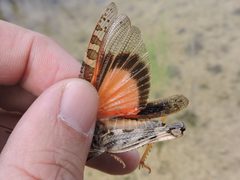
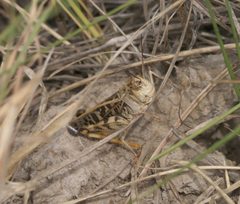
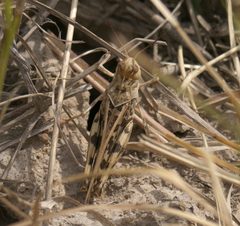
A large, robust band-winged grasshopper and the sole member of its . Distinguished by surface sculpturing on the pronotum with a single cut, orange hind tibia, and triple-banded inner surface of the hind with basal blue coloration. Coloration is generally brownish, though some individuals exhibit reddish and pronota. Active in fall, with present from late summer through autumn.
Pronunciation
How to pronounce Hippiscus ocelote: /hɪˈpɪskəs oʊˈsɛloʊtɛ/
These audio files are automatically generated. While they are not always 100% accurate, they are a good starting point.
Identification
Pronotum has a single cut (notch) and distinctive wrinkled or sculptured surface texture—hence the . Hind tibia is orange. Inner surface of hind displays three dark bands with blue coloration at the base. Large, heavy-bodied build compared to many co-occurring grasshoppers. Coloration ranges from uniformly brownish to individuals with pronounced reddish and pronota.
Images
Habitat
Dry, open including xeric grasslands, glade margins, and dry woodlands. Associated with rocky outcrops and exposed rhyolite formations in some regions.
Distribution
North America. Documented from Missouri, Colorado, Wyoming, Nebraska, and surrounding Great Plains and Ozark regions. Records extend to Alabama, Illinois, Massachusetts, Maryland, and northeastern Mexico.
Seasonality
active in fall; field observations from September through October.
Behavior
Possesses cryptic coloration that makes individuals difficult to relocate after jumping. When disturbed, may reveal bright hind leg coloration during escape movements.
Similar Taxa
- Trimerotropis saxatilisBoth occur on rocky glades and share cryptic coloration, but T. saxatilis is smaller with lichen-matching green and black patterning rather than brown or reddish tones and sculptured pronotum.
- Melanoplus ponderosusCo-occurs in dry woodland margins and is similarly robust, but lacks the orange hind tibia, triple-banded hind , and sculptured pronotum of H. ocelote.
Sources and further reading
- BugGuide
- GBIF taxonomy match
- iNaturalist taxon
- NCBI Taxonomy
- Catalogue of Life
- Grasshoppers of Colorado
- Grasshoppers of Colorado
- Grasshoppers of Colorado
- Species Records and Accounts
- 🪲 Entomologizing w/ the WGNSS Entomology Group at Hughes Mountain Natural Area — 11 Oct 2025 | Beetles In The Bush
- Saltatorial sidetracks | Beetles In The Bush