
Trimerotropis saxatilis
McNeill, 1901
lichen grasshopper
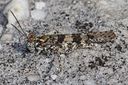
Trimerotropis saxatilis, commonly known as the lichen grasshopper, is a band-winged grasshopper ( Oedipodinae) renowned for its exceptional cryptic coloration that renders it nearly invisible against lichen-encrusted rock surfaces. The exhibits striking intraspecific color variation, ranging from vivid blue-green individuals matching crustose lichens to darker brown and black forms adapted to barren rock exposures. It inhabits fragmented glade in the Ozark Highlands and adjacent regions, where remain small and isolated due to forest barriers limiting .
Pronunciation
How to pronounce Trimerotropis saxatilis: /ˌtraɪmɛroʊˈtroʊpɪs səbˈsaɪstən/
These audio files are automatically generated. While they are not always 100% accurate, they are a good starting point.
Identification
The only member of Trimerotropis occurring in the eastern United States, making it immediately recognizable in that region. Distinguished from other oedipodine grasshoppers by its specific association with lichen-encrusted rock glades and its unique blue-green color morphs. The combination of (rock glades), color variability, and geographic location (eastern Ozarks and adjacent areas) separates it from western such as T. latifasciata, which occurs on clay exposures in the Great Plains and has longer wings and red hind tibiae.
Images
Habitat
Sandstone and igneous glades—xeric, rocky openings with exposed bedrock and crustose lichen cover. Found specifically on lichen-encrusted rock outcroppings and adjacent barren rock exposures. Closed- forest surrounding glades acts as primary barrier.
Distribution
Ozark Highlands of southern Missouri (eastern limit of range), north-central Arkansas (Calico Rock area), and westward through eastern Oklahoma and Kansas to Illinois and southern Georgia. Fragmented distribution with isolated restricted to glade .
Seasonality
active in summer; observations from June documented. Nymphs present in spring (third instar nymphs observed in April).
Life Cycle
Hemimetabolous development with nymphal stages. Third instar nymphs have been observed with well-developed wing pads. stage not explicitly documented in sources.
Behavior
Exhibits remarkable —remains motionless on lichen-covered rocks, becoming virtually invisible. When approached, performs short escape with interrupted buzzing (sound produced by wing rubbing). Flight not highly erratic; individuals can be tracked to landing sites and relocated with careful observation. Slow, deliberate movements allow close approach once detected.
Ecological Role
Herbivore in glade . sizes small (<280 individuals per glade) with limited movement within moderately subdivided glades. No among isolated populations due to forest barriers.
Human Relevance
Subject of ecological and behavioral research on and in fragmented . Popular among insect photographers and naturalists for its aesthetic appeal and challenging detection. No agricultural or economic significance documented.
Similar Taxa
- Trimerotropis latifasciataBroad-banded ; similar and cryptic strategy but occurs on clay (not rock) in Great Plains, has longer wings, and red hind tibiae. Geographic separation and substrate preference aid distinction.
- Hippiscus oceloteWrinkled grasshopper; shares glade and cryptic coloration but distinguished by robust body, single pronotal notch, orange hind tibia, and triple-banded blue inner hind surface.
More Details
Population Structure
Capture-mark-recapture studies in Missouri found small, isolated with effective breeding sizes exceeding sizes. Movement studies showed grasshoppers can traverse moderately subdivided glades but do not cross closed- forest, resulting in zero among populations.
Color Polymorphism Function
Multiple color morphs (green, brown, black) represent to heterogeneous microhabitats within glades—green forms match lichen-encrusted rock, while darker forms match barren rock exposures. This diversity results from conflicting across the mosaic glade environment.
Sources and further reading
- BugGuide
- Wikipedia
- GBIF taxonomy match
- iNaturalist taxon
- NCBI Taxonomy
- Catalogue of Life
- Oedipodine Rex | Beetles In The Bush
- 2013 ESA World of Insects Calendar Selection | Beetles In The Bush
- Acrididae | Beetles In The Bush | Page 3
- More on ‘Conspicuous Crypsis’ | Beetles In The Bush
- orb weavers | Beetles In The Bush
- swallowtail butterflies | Beetles In The Bush
- Population Energetics and Ecology of the Rock Grasshopper, Trimerotropis Saxatilis
- Population sizes and within-deme movement of Trimerotropis saxatilis (Acrididae), a grasshopper with a fragmented distribution