
Pardalophora apiculata
(Harris, 1835)
Coral-winged Grasshopper, Coral-winged Locust
Pardalophora apiculata, commonly known as the coral-winged , is a large band-winged grasshopper in the Oedipodinae. Females reach up to 60 mm in body length, making them among the largest spring grasshoppers in their range. The exhibits striking in size and possesses vivid pinkish-orange to coral-colored hindwings that are concealed at rest by cryptic forewings. It is a spring-active species with present primarily from April through June, with nymphs to complete development the following spring.
Pronunciation
How to pronounce Pardalophora apiculata: //pɑrˌdæloʊˈfɔrə ˌæpɪˈkjʊlætə//
These audio files are automatically generated. While they are not always 100% accurate, they are a good starting point.
Identification
Distinguished from similar Pardalophora and Xanthippus corallipes by: uniformly yellow or orange inner of hind (not banded or spotted); yellow hind tibia; tegmina with far fewer spots and blotches than Pardalophora haldemanii or other ; hindwings pinkish-orange to coral rather than yellow. The combination of large body size, spring activity period, and coral-colored hindwings is diagnostic. Nymphs can be identified by the bandwinged characteristics: height of pronotal carina, position and length of lateral carinae, and color patterns of hindlegs.
Images
Appearance
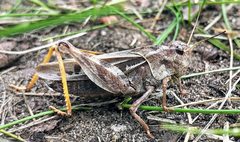
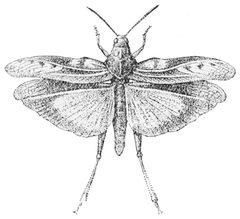
Large, robust band-winged grasshopper with powerful hind legs adapted for jumping. Body, legs, and forewings (tegmina) are cryptically colored in variable shades of light gray, gray-brown, beige, or olive, with a criss-cross pattern of pale lines and dark blotches that provide excellent camouflage against prairie substrates. Hindwings are the ' most distinctive feature: bright pinkish-orange, orange, or pale red with a dark submarginal band and clear wing edge. When folded at rest, hindwings are concealed entirely beneath the tegmina. Females are substantially larger than males, reaching 50-60 mm in body length versus 30 mm or more for males. The inner of the hind is uniformly yellow or orange, and the hind tibia is yellow.
Habitat
Sandy soils in prairie , including shortgrass and mixed-grass prairies; also occurs in forest openings and edges. Prefers open, well-drained areas with sparse to moderate grass cover. frequently found on gravel roads and bare ground where their cryptic coloration blends with substrates.
Distribution
North America, with a distribution resembling an inverted bell curve. Ranges from southern Canada (Yukon Territory, Northwest Territories, central Quebec) south through the Great Plains and intermountain West to Arkansas, Oklahoma, Tennessee, western Virginia, and New England. Absent or rare from the southeastern United States and far western coastal regions.
Seasonality
active primarily April through June, occasionally appearing as early as mid-March in southern portions of range. Adults disappear by July. Nymphs emerge from in July and August, overwinter, and mature the following spring. In northernmost latitudes, the may extend to two years with an additional winter spent as eggs.
Diet
Graminivorous; feeds primarily if not exclusively on grasses. Both nymphs and consume grass , with no documented significant feeding on forbs or other plant groups.
Life Cycle
occurs in the nymphal stage. are deposited in soil pods during summer. Nymphs hatch in July-August, develop through several instars, and overwinter as late-instar nymphs. emerge in spring following final . In northernmost , eggs may undergo a period of extending the cycle to two years.
Behavior
Strong flier despite large body mass; when flushed, take with striking display of coral hindwings. Flight is typically short and low, with individuals often landing nearby. Considered non-migratory despite flight capability, existing in relatively compact, localized . Adults are and active during warm periods of spring days. Males produce acoustic signals through stridulation and (wing-snapping in flight) for mate attraction and territorial communication.
Ecological Role
Primary consumer in grassland ; contributes to nutrient cycling through herbivory on grasses. Serves as prey for various vertebrate and including birds, rodents, and predatory insects. Not considered a but contributes to diversity in prairie .
Human Relevance
Not an economically significant pest ; rarely occurs in densities high enough to cause agricultural damage. Occasionally noticed by humans when flushed from roadsides, sometimes striking vehicles. Of interest to entomologists and naturalists for its striking hindwing coloration and large size. No documented direct beneficial uses.
Similar Taxa
- Pardalophora haldemanii (Haldeman's Grasshopper)Similar size and spring activity period, but has more heavily spotted tegmina and different hindwing coloration; hind markings differ
- Xanthippus corallipes (Red-shanked Grasshopper)Overlapping spring activity and similar use, but has yellow hindwings rather than coral-pink, and banded or spotted inner hind
- Pardalophora phoenicopteraSimilar coral or pinkish hindwings, but geographic range differs and tegminal spotting patterns vary
More Details
Population Dynamics
Not a swarming or gregarious ; remain relatively stable and localized. may fly long distances individually but do not form migratory swarms.
Taxonomic History
Described by Thaddeus William Harris in 1835. The specific epithet 'apiculata' refers to the small pointed tips of the tegmina. The Pardalophora is derived from Greek roots referring to spotted appearance.