
Dendrotettix zimmermanni
(Saussure, 1861)
Carolina Oak Grasshopper
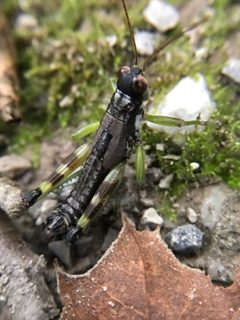
Dendrotettix zimmermanni, commonly known as the Carolina oak , is a of spur-throated grasshopper in the Acrididae. It is native to North America, with records indicating presence in the southeastern United States. As a member of the Melanoplinae and tribe Podismini, it belongs to a group of grasshoppers often associated with woody vegetation.
Pronunciation
How to pronounce Dendrotettix zimmermanni: //ˌdɛn.droʊˈtɛt.ɪks ˌzɪm.ərˈmæn.aɪ//
These audio files are automatically generated. While they are not always 100% accurate, they are a good starting point.
Identification
As a spur-throated grasshopper, Dendrotettix zimmermanni possesses a distinctive projection on the throat (the 'spur') that separates it from non-spur-throated grasshoppers. Within the Dendrotettix, identification to level requires examination of morphological details such as male genitalia, tegminal (forewing) venation patterns, and body proportions. The specific epithet 'zimmermanni' honors an individual, though the exact namesake is not documented in available sources.
Images
Habitat
The 'Carolina oak ' suggests association with oak-dominated , though specific microhabitat preferences are not documented. Members of the Dendrotettix are typically found in wooded or forest-edge environments rather than open grasslands.
Distribution
Documented from the southeastern United States. GBIF records indicate presence in North America with specific mention of the southeastern U.S.A. The exact range boundaries are not well-defined in available sources.
More Details
Taxonomic Note
The was first described by Henri Louis Frédéric de Saussure in 1861. The name Dendrotettix combines Greek elements suggesting 'tree' (dendron) and '' (tettix), reflecting the arboreal or tree-associated habits of species in this genus.
Data Limitations
This is notably understudied. As of the knowledge cutoff, only 10 observations were recorded on iNaturalist, and no dedicated scientific studies of its , , or were identified in the provided sources. Most information must be inferred from higher-level taxonomic characteristics of the Acrididae and Melanoplinae, which is methodologically unsound for a species-level account.