
Podismini
Jacobson, 1905
spur-throated grasshoppers
Genus Guides
12- Agnostokasia
- Appalachia
- Asemoplus
- Booneacris(Wingless Mountain Grasshoppers)
- Bradynotes(Slow Mountain Grasshoppers)
- Buckellacris
- Dendrotettix
- Hebardacris(Mount Whitney grasshopper (for H. albida))
- Hypsalonia
Podismini is a tribe of spur-throated grasshoppers within the Melanoplinae of the Acrididae. It is distinguished from other Melanoplinae tribes by a northern hemisphere distribution, with substantial representation outside the Americas. The tribe comprises approximately 12 and at least 20 described , organized into four subtribes (Miramellina, Podismina, Tonkinacridina) and one genus group (Bradynotae). Members are characterized by winglessness or reduced wings in many species, particularly in montane and temperate lineages.
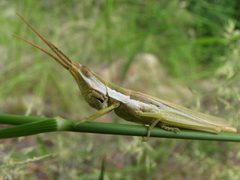
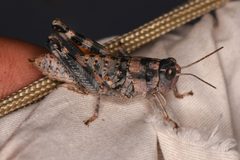
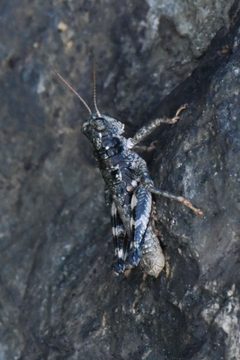
Pronunciation
How to pronounce Podismini: /pɒdɪsˈmɪnaɪ/
These audio files are automatically generated. While they are not always 100% accurate, they are a good starting point.
Identification
Members of Podismini can be distinguished from other Melanoplinae tribes by the combination of a spur on the (the 'spur-throated' condition) and the characteristic male genitalia structure. The tribe includes many brachypterous or (short-winged or wingless) , particularly in montane such as Boonacris, Appalachia, and Dendrotettix. Subtribe-level identification requires examination of phallic complex and, in some cases, cytogenetic characters. Miramellina is restricted to mainland Europe and East Asia; Podismina occurs across North America, Europe, and Asia; Tonkinacridina is Asian; and Bradynotae occurs in North America and East Asia.
Images
Habitat
vary by subtribe and . Miramellina are found in montane and alpine meadows of mainland Europe, China, Korea, and Japan. Podismina occupies diverse temperate habitats including North American deciduous forests (Appalachia, Dendrotettix, Boonacris), Eurasian grasslands, and Asian montane regions. Tonkinacridina is distributed across Asian habitats. Bradynotae species occur in North American and East Asian temperate zones. Many species are associated with high-elevation environments; the genus Alulacris was collected at 1778 m in Yunnan, China.
Distribution
Northern hemisphere distribution with substantial representation outside the Americas, distinguishing Podismini from other Melanoplinae tribes. Miramellina: mainland Europe, China, Korea, Japan. Podismina: North America (approximately 12 ), Europe, Asia through to Japan. Tonkinacridina: Asia. Bradynotae: North America and East Asia. The genus Alulacris is to Yunnan Province, China.
Behavior
Many are wingless or have reduced wings, limiting ability. The cytogenetic study of Boonacris suggests extreme karyotypic stability within , with numbers of 2n = 20 (female) and 21 (male, XO sex determination). Related Appalachia and Dendrotettix have 2n = 22 (female) and 23 (male).
Similar Taxa
- Other Melanoplinae tribesDistinguished from Dactylotini, Melanoplini, and other Melanoplinae tribes by northern hemisphere distribution with major representation in Eurasia; other tribes are predominantly Nearctic in distribution.
- Catantopinae (historical placement)Some Podismini were historically classified in Catantopinae; molecular based on complete mitogenomes confirms placement in Melanoplinae.
More Details
Subtribal Classification
The tribe comprises four subtribes and one group: Miramellina (Europe, East Asia), Podismina ( northern temperate), Tonkinacridina (Asia), and Bradynotae (North America, East Asia). The subtribe structure reflects both geographic and morphological patterns.
Cytogenetic Evolution
Evidence from multiple podismine suggests that forms with lower numbers (2n = 20/21) may have originated from a 'proto-Podisma' ancestor with 2n = 23 via evolutionary loss or elimination of a small, unstable megameric chromosome pair. This dichotomy separates major phyletic lineages within the tribe.
Taxonomic Revisions
The Alulacris was transferred from Catantopinae incertae sedis to Podismini subtribe Podismina based on complete mitogenome evidence and morphological similarity to Yunnanacris. This exemplifies ongoing refinement of tribal boundaries using molecular data.
Sources and further reading
- BugGuide
- Wikipedia
- iNaturalist taxon
- NCBI Taxonomy
- Catalogue of Life
- CYTOTAXONOMIC STUDIES ON THE GENUS BOONACRIS: I. The "eastern" taxa and a comparison with the related genera Dendrotettix and Appalachia (Orthoptera: Catantopidae: Podismini)
- Phylogenetic Position of the Genus Alulacris (Orthoptera: Acrididae: Melanoplinae: Podismini) Revealed by Complete Mitogenome Evidence.