
Melanoplus bowditchi
Scudder, 1878
Sagebrush Grasshopper
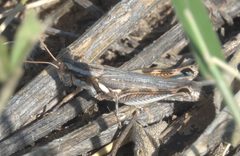
Melanoplus bowditchi, commonly known as the sagebrush , is a medium-sized spurthroated grasshopper in the Melanoplinae. It is widely distributed across western North American grasslands where sagebrush is present. The exhibits strong plant specificity, feeding almost exclusively on sagebrush species, particularly silver sagebrush (Artemisia cana) and sand sagebrush (A. filifolia). Despite its potential to damage valuable forage plants, remain at low densities and significant economic impact has not been documented.
Pronunciation
How to pronounce Melanoplus bowditchi: /mɛˈlænoʊpləs ˈbaʊdɪtʃaɪ/
These audio files are automatically generated. While they are not always 100% accurate, they are a good starting point.
Identification
Distinguished from other Melanoplus by the elongated, slender shape of the male . Nymphs identifiable by: nearly vertical with slightly receding profile; with pale yellow spots; pale yellow crescent on gena below running onto lateral pronotal lobe; pronotal disk medium gray or brown with fuscous spots, darker than lateral lobes; hind with dark stripe centrally located in instars I–II, shifting dorsally in instars III–V; hind tibia pale gray in instars I–IV, pale blue in instar V with fuscous front surface in all instars.
Images
Appearance
Pale to dark gray medium-sized . Wings long, extending 3–5 mm beyond tip. Hind medial area marked by chevrons separated by white lines, darker dorsally and lighter ventrally. Hind tibiae light to medium blue. Male elongated and slender, an essential diagnostic character. Live weights average 394 mg (males) and 434 mg (females); dry weights 80 mg and 144 mg respectively.
Habitat
Inhabits mixedgrass, shortgrass, desert, and bunchgrass prairies, and certain desert shrub . Distribution within these units depends entirely on presence of sagebrush. Specifically associated with silver sagebrush in mixedgrass prairie and sand sagebrush on sand dunes and sand hills where silver sagebrush is absent.
Distribution
Widely distributed in western North American grasslands. Recorded from Colorado, Montana, Oklahoma, and throughout the western United States and adjacent Canada. Range closely matches the combined geographic distributions of its primary plants, silver sagebrush and sand sagebrush.
Seasonality
begin hatching first week of June in eastern Wyoming mixedgrass prairie, approximately three weeks after bigheaded grasshopper hatching. Nymphal development takes 30–40 days. appear first week of July, with nymphal molting continuing for up to one month. Adults present July through September.
Diet
Feeds almost exclusively on sagebrush . Primary plants are silver sagebrush (Artemisia cana) and sand sagebrush (A. filifolia). Crop contents in western North Dakota contained 97% silver sagebrush and 5% fringed sagebrush; in western Nebraska, 88% sand sagebrush with remainder undetermined forbs and pollen. Four other species—big sagebrush, fringed sagebrush, tarragon, and cudweed sagewort—ingested in small amounts. have been observed feeding horizontally on ground-dwelling lichens.
Host Associations
- Artemisia cana - primary Silver sagebrush; preferred in mixedgrass prairie, 97% of crop contents in North Dakota
- Artemisia filifolia - primary Sand sagebrush; in sand dune and sand hill where A. cana is absent
- Artemisia tridentata - secondary Big sagebrush; ingested in small amounts
- Artemisia frigida - secondary Fringed sagebrush; 5% of crop contents in North Dakota
- Artemisia dracunculus - secondary Tarragon; ingested in small amounts
- Artemisia ludoviciana - secondary Cudweed sagewort; ingested in small amounts
Life Cycle
tan, 4.5–4.9 mm long, deposited in pods approximately 19 mm (three-quarters inch) long containing 12–13 eggs surrounded by froth and held by scant accessory gland secretion. Females oviposit readily in bare soil; one observed ovipositing for at least 30 minutes, attended by male, then covering hole by working ovipositor back-and-forth and sideways. Five nymphal instars.
Behavior
Phytophilous spending much of daily life on plant. Nymphs and roost 6–16 inches high on silver sagebrush stems at night, up. Remain in resting positions for approximately two hours after sunrise, then adjust to expose sides or backs to sun. By 9 a.m. many jump to ground to bask horizontally, turning side perpendicular to sun and lowering exposed hindleg. When soil surface reaches 70°F (~10 a.m.), become active and return to host to feed. Late afternoon basking occurs before roosting resumes by 6–7 p.m. Evasive silent, straight, 12–15 inches high, 1.5–12 feet long; usually land on vegetation including host plant or grass culm. Feeding includes attacking leaf edges, cutting leaf at base and holding with front to consume entire leaf, and feeding on flowers when available.
Ecological Role
Herbivore specialized on sagebrush . Potentially damaging to silver sagebrush, which provides good to excellent fall and winter browse for livestock and game animals, though low densities prevent significant impact. Serves as prey for vertebrate and in grassland .
Human Relevance
Potential pest of valuable forage plant (silver sagebrush), but economic damage does not occur due to consistently low densities. Insignificant component of . May be encountered during rangeland surveys using sweep nets near plants.
Similar Taxa
- Melanoplus borealisAdjacent in sequence; distinguished by male shape and coloration patterns
- Melanoplus bruneriAdjacent in sequence; M. bowditchi distinguished by elongated slender male and specific sagebrush association
- Other Melanoplus speciesMale shape is essential diagnostic character; M. bowditchi has elongated slender cercus unlike the short boot-shaped cercus of M. bivittatus or other
More Details
Subspecies
Two recognized: M. bowditchi bowditchi Scudder, 1878 and M. bowditchi canus Hebard, 1925, both occurring in North America. The nominate subspecies is explicitly called Sagebrush .
Population Ecology
Extensive range with patchy limited by plant distribution. , , mortality, and capacity for increase remain unstudied. Courtship, mating, and oviposition in nature have not been observed.
Dispersal Capacity
Long wings extending beyond suggest capacity for and , though little is known. Observed evasive are short and low.