
Melanoplus borealis
(Fieber, 1853)
Northern Spur-throat Grasshopper, Northern Grasshopper
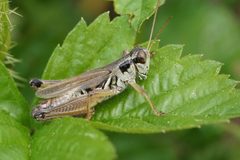
Melanoplus borealis is a spur-throated grasshopper in the Acrididae, distributed across North America from Alaska to the Great Plains. It inhabits moist, open including swamps, wet bogs, and mountain meadows. The exhibits a late-hatching seasonal cycle, with and hatching in mid-June. It is primarily a forb feeder, though capable of surviving on grasses under laboratory conditions. are typically small even in suitable habitats. In Nebraska, it is recognized as a glacial relict that remained undetected for over a century before its rediscovery in 2007.
Pronunciation
How to pronounce Melanoplus borealis: //mɛˈlænoʊpləs bɔˈriælɪs//
These audio files are automatically generated. While they are not always 100% accurate, they are a good starting point.
Images
Habitat
Moist, open environments including swamps, wet bogs, moist mountain meadows, and lowland wetlands. In Alaska, occupies sunny open fields with short, sparse vegetation allowing sunlight penetration to ground level. Nebraska occur in wetland areas.
Distribution
North America, including Alaska (Fairbanks area), western mountain states, Great Plains (Nebraska, South Dakota Black Hills), and subarctic regions. Documented in California, Colorado, Illinois, and Indiana. Nebraska confirmed in seven counties including Cherry, Lincoln, and Sioux counties.
Seasonality
Late-hatching ; overwinter from September to June. Hatching occurs in mid-June within 10-15 days. Nymphs develop for approximately 45 days, reaching adulthood in late summer. Sexual maturity attained about 3 weeks after .
Diet
Primarily forb feeder based on mandibular . Capable of developing and reproducing exclusively on Gramineae (grasses) under laboratory conditions. Field observations indicate feeding on forbs with occasional consumption of grasses or crops.
Life Cycle
Overwinters as in soil from September to June. Eggs hatch in mid-June within 10-15 days. Nymphs undergo 5 , reaching adulthood in approximately 45 days. Sexual maturity attained about 3 weeks after . Oviposition begins 8-10 days after sexual maturity. One-year in most ; potentially two-year cycle in some mountain populations.
Behavior
activity pattern. typically remain small and localized even within suitable . In Nebraska, persisted as undetected populations for over a century (1900-2007) despite prior historical occurrence.
More Details
Subspecies
Four recognized: M. borealis borealis (Fieber, 1853), M. borealis palaceus Fulton 1930, M. borealis stupefactus (Scudder, 1876), and M. borealis utahensis Scudder 1897.
Conservation Status
In Nebraska, characterized as a glacial relict with fragmented distribution. Historical collections prior to 1900 followed by century-long absence of records suggests potential vulnerability in peripheral .
Sources and further reading
- BugGuide
- Wikipedia
- GBIF taxonomy match
- iNaturalist taxon
- NCBI Taxonomy
- Catalogue of Life
- Grasshoppers of Colorado
- Species Records and Accounts
- Grasshoppers of Colorado
- List of Species Fact Sheets| Grasshoppers of Wyoming and the West
- Twostriped Grasshopper
- Field Guide
- Occurrence and distribution of Melanoplus borealis (Fieber) as a glacial relict in Nebraska
- Biology and Ecology of Melanoplus Borealis (Orthoptera: Acrididae) in Fairbanks, Alaska with Special Reference to Feeding Habits
- Fig 3 from: Brust ML, Hill J (2026) Occurrence and distribution of Melanoplus borealis (Fieber) as a glacial relict in Nebraska. Journal of Orthoptera Research 35(1): 83-86. https://doi.org/10.3897/jor.35.137718