
Aidemona
Brunner von Wattenwyl, 1893
Aztec spur-throat (for A. azteca)
Species Guides
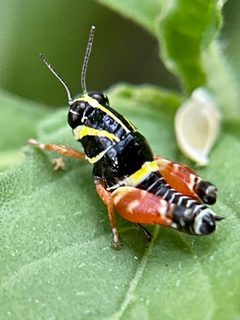
1- Aidemona azteca(Aztec Spur-throated Grasshopper)
Aidemona is a of spur-throated grasshoppers in the Acrididae, established by Brunner von Wattenwyl in 1893. The genus contains five described distributed primarily in Mexico and Central America. The best-known member is Aidemona azteca, commonly called the Aztec spur-throat. These grasshoppers belong to the Melanoplinae, a diverse group of New World grasshoppers.

Pronunciation
How to pronounce Aidemona: //aɪdɛˈmoʊnə//
These audio files are automatically generated. While they are not always 100% accurate, they are a good starting point.
Identification
Members of this are spur-throated grasshoppers, characterized by a distinct peg-like or tubercular projection on the (the surface of the first thoracic segment). As Melanoplinae, they possess short , enlarged hind legs adapted for jumping, and typically exhibit relatively slender body proportions compared to some other acridid . -level identification requires examination of male genitalia and subtle differences in coloration and pronotal shape.
Images
Habitat
occur in varied terrestrial across their range, from lowland to montane environments. Aidemona alticola, as the name suggests, has been associated with higher elevations.
Distribution
Mexico, Guatemala, El Salvador, Rica, and Colombia. The shows a predominantly Mesoamerican distribution with some South American representation.
Ecological Role
As herbivorous orthopterans, members of this contribute to nutrient cycling through plant consumption and serve as prey for various vertebrate and .
Similar Taxa
- MelanoplusBoth belong to Melanoplinae and share the spur-throated condition; Aidemona tend to have more restricted geographic ranges and differ in male genitalic structure.
- SphenariumAnother New World melanopline with spur-throated ; distinguished by differences in pronotal shape and geographic distribution.
More Details
Taxonomic history
The was established by Brunner von Wattenwyl in 1893. Four of the five were described by H.R. Roberts in 1947, with A. scarlata described more recently in 2003.