
Aeoloplides turnbulli
(Thomas, 1872)
thistle grasshopper, Russian thistle grasshopper, saltbush grasshopper
Aeoloplides turnbulli is a medium-sized, robust spur-throated grasshopper in the Acrididae, commonly known as the thistle or Russian thistle grasshopper. The exhibits two recognized : A. t. turnbulli in the north and A. t. bruneri in the south, distinguished primarily by wing length. It is an early-hatching species with a prolonged nymphal development period of 50–60 days. The species has demonstrated potential, with historical irruptions documented in western Kansas during the 1930s and in the Big Horn Basin, Wyoming, in 1993.
Pronunciation
How to pronounce Aeoloplides turnbulli: /ˌeɪ.əˈlɑː.plɪˌdiːz ˈtɝːn.bʊˌlaɪ/
These audio files are automatically generated. While they are not always 100% accurate, they are a good starting point.
Identification
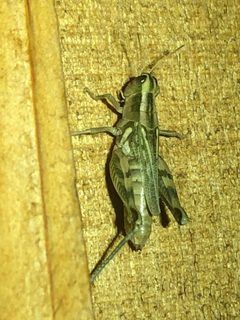
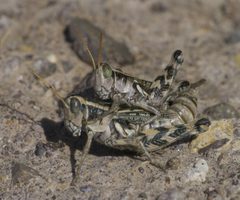
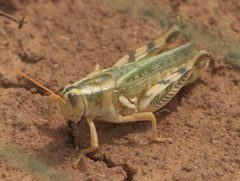
are medium-sized and robust with distinctive tan coloration and fuscous markings. The pronotal disk displays lateral light bands separated by a broad fuscous band divided by the carina, which may be partly or entirely light tan. The hind bears three characteristic fuscous marks on the medial area that usually extend dorsally onto upper marginal areas. The hind tibia is typically medium blue with a pale tan annulus near the base. Males possess minute lobes, a subgenital plate with a conspicuous subapical , and triangular slender . The two differ in wing length: A. t. turnbulli has wings 2–4 mm short of the tip (sometimes 3–6 mm short of the hind femur in Big Horn Basin ), while A. t. bruneri has wings surpassing the abdomen end. Nymphs are identifiable by the pronotal disk shape, which widens distinctly from front to rear—a diagnostic character.
Images
Habitat
Inhabits desert shrub sites, local alkali flats vegetated with saltbush and black greasewood, and grasslands where forbs occur. Does not feed on grasses. In Wyoming, occurs in desert shrub associations dominated by saltbush (Atriplex spp.), particularly Gardner saltbush in the Big Horn Basin. Also found in disturbed sites, crop borders, weedy rangeland, and roadsides with abundant chenopod weeds.
Distribution
Western North America from southern Canada to northern Mexico. Documented in Colorado, Kansas, Nebraska, New Mexico, and Wyoming. In Wyoming, primarily recorded from the Big Horn Basin and eastern regions; underrepresented in standard rangeland surveys due to association with weedy . Two accidentals of the southern A. t. bruneri collected in mountains west of Boulder, Colorado, at 7,700 and 12,100 feet elevation demonstrate capability.
Seasonality
Early-hatching . First instars appear in late April to early May in eastern Wyoming weedy , and one to two weeks earlier in Big Horn Basin desert shrub. Hatching period extends four to five weeks. appear mid-June in Big Horn Basin, late June in southeastern Wyoming weedy sites.
Diet
Obligate feeder on Chenopodiaceae (goosefoot ). Principal plants include shrubs: fourwing saltbush, Gardner saltbush, white sage/winterfat (Ceratoides lanata), and black greasewood; and stout herbs: kochia, Russian thistle, and lambsquarters. Feeds selectively on young tissue, climbing to growing tips from roosting positions. Field observations and gut analyses indicate sparing consumption of forbs from at least six additional plant families, but Chenopodiaceae dominates.
Life Cycle
Overwinters as in soil. Hatching begins late April to early May; extended hatching period lasts 4–5 weeks. Five nymphal instars required for both sexes; nymphal period lasts 50–60 days due to robust body development, early spring hatching, and cooler ambient temperatures on plants. appear June–July. Oviposition occurs in bare ground; observed attempts in August at soil surface temperatures of 120–121°F. Egg pods are stubby, 7/16 inch long, 3/16 inch diameter, slightly curved with sloping cap and pinched top. Pods lack froth plug but have reddish-brown froth surrounding egg mass. Eggs light-reddish brown to tan, 4.0–4.4 mm long, 12–18 per pod. High : caged females averaged 250 eggs each in Canada. One annually.
Behavior
Phytophilous spending much time on plants. Nymphs and roost vertically -up on shrub stems at night; some rest on ground litter. Basking begins one hour after sunrise, lasting approximately two hours, achieved by adjusting position to expose sides or back to sun, sometimes lowering a hindleg. Ground basking occurs in sparse vegetation . Daily activities include feeding on growing tips, molting, short-distance , and mating. Mating pairs occupy both host plants and ground. When flushed, adults fly silent, straight, low (4–6 inches height) for average 3.6 feet, usually landing away from intruder. During midday ground temperatures exceeding 120°F, grasshoppers face away from sun and stilt, or seek shade under vegetation. Evening cooling triggers renewed activity and basking before shelter-seeking at sunset.
Ecological Role
irruptions can significantly impact chenopod shrub . In desert shrub , damage to valuable forage chenopods including Gardner saltbush, fourwing saltbush, and winterfat reduces winter livestock forage. In disturbed habitats, plays beneficial role by feeding on growing points of weedy chenopods (kochia, Russian thistle, lambsquarters), reducing seed production and foliage. Serves as prey for various vertebrate and ; subject to (population in Kansas 1941 nearly eliminated by undetermined ).
Human Relevance
Economic status context-dependent: pest when damaging sugar beets (western Kansas 1938), wheat-adjacent Russian thistle (though crop damage avoided when preferred abundant), or valuable rangeland forage chenopods; beneficial when suppressing weedy chenopods on disturbed land. Underrepresented in standard APHIS rangeland surveys due to preferences, leading to potential underestimation of local abundance. Large size places it in largest third of rangeland grasshoppers (females 548 mg live weight, males 296 mg in Gardner saltbush habitats).
Similar Taxa
- Hesperotettix viridisBoth are spur-throated grasshoppers (Melanoplinae) with green and spotted color forms, but H. viridis feeds on Compositae (snakeweeds, rabbitbrush) rather than Chenopodiaceae, has longer wings reaching or nearly reaching tip, and displays light line on pronotum absent in A. turnbulli. H. viridis nymphs have with pale annuli and different hind markings.
- Melanoplus bivittatusShares early hatching and overlapping in eastern Wyoming, but M. bivittatus is a feeder on grasses and forbs with distinctive pale stripes on back and wings, lacks the robust chenopod- , and has different pronotal proportions.