
Gymnoscirtetes rex
Hill, 2022
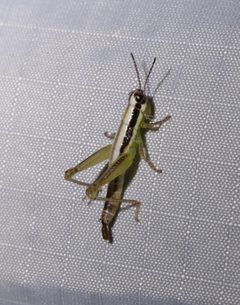
Gymnoscirtetes rex is a recently described flightless (Orthoptera: Acrididae: Melanoplinae) to the Florida panhandle region of the southeastern North American Coastal Plain. It was described in 2022 as one of four new species in a revision of the Gymnoscirtetes. The species belongs to the morsei species group, characterized by distinctive male genital including falcate and a subgenital plate with dorsally expanded lateral lobes. are small (males 11.8–17 mm, females 17.5–22.2 mm) with wings, gracile body form, and brownish-green to bronze coloration with a black post-ocular stripe.
Pronunciation
How to pronounce Gymnoscirtetes rex: /ˌdʒɪmnəˈskɜrtɪtiːz rɛks/
These audio files are automatically generated. While they are not always 100% accurate, they are a good starting point.
Identification
Distinguished from the closely related G. morsei by three key male genital characters: narrower subgenital plate tubercule; less falcate and sometimes rounded apex; and more valves of the . Distinguished from other Gymnoscirtetes by geographic range (east of the Ocklochnee River in Florida panhandle) and the combination of gracile form, wings, and brownish-green or bronze coloration with black post-ocular stripe. The flightless condition and preference for mesic grasslands help separate it from co-occurring species with functional wings.
Images
Appearance
Small, gracile with wings (minute, -like, rendering the flightless). Body coloration brownish-green or bronze with a distinct black post-ocular stripe. Hind tibia pale dull green. in size: males 11.8–17 mm, females 17.5–22.2 mm. Male falcate (curved like a sickle) with apex less falcate and sometimes rounded compared to related species. Subgenital plate with dorsally expanded lateral lobes and a tubercule that is longer than wide but narrower than in G. morsei.
Habitat
Primarily associated with mesic grasslands of the southeastern North American Coastal Plain. Most commonly found in pitcher plant bogs, flatwoods, and edges of seasonal ponds. Occasionally occurs in grassy sandhills. Specifically inhabits low, moist, open portions of flatwoods, particularly areas sloping to and bordering bayheads, bogs, fens, hydric hammocks, swamps, or seasonal ponds. Within these , individuals are found among dense patches of grass or tall slender vegetation where their gracile form and lateral striping provide effective camouflage.
Distribution
to the central to eastern portion of the Florida panhandle, specifically east of the Ocklochnee River. Represents the eastern range limit of the morsei group, which extends westward from this point to Mobile Bay, Alabama.
Behavior
Flightless due to wings. Effective achieved through gracile body form and lateral striping when positioned among dense grass or tall slender vegetation. A pair in copula has been observed, indicating mating in the field.
Ecological Role
Functions as a herbivore in the temperate grassland systems it inhabits. As a flightless of mesic grassland , it likely contributes to nutrient cycling and serves as prey for and vertebrate within these .
Similar Taxa
- Gymnoscirtetes morseiOverlaps in geographic range (morsei group extends from Mobile Bay, Alabama to Ocklochnee River, Florida) and shares falcate male , subgenital plate with dorsally expanded lateral lobes, and morsei group characteristics. Distinguished by broader subgenital plate tubercule, more falcate cercus apex, and less valves of the in males.
- Gymnoscirtetes pusillusCo-occurring congeneric in the southeastern Coastal Plain; distinguished by pusillus species group characteristics and geographic distribution patterns.
More Details
Taxonomic history
Described in 2022 by Hill as part of a comprehensive revision of the Gymnoscirtetes, which expanded the genus from two to six recognized based on male genital and geographic data.
Conservation context
The mesic grassland preferred by this —including pitcher plant bogs and flatwoods—are among the most threatened in the southeastern United States due to fire suppression, drainage, and development, potentially putting this narrowly flightless species at risk.
Etymology
The specific epithet 'rex' is Latin for 'king', continuing a pattern of noble titles in recently described Cyrtodactylus geckos from New Guinea (C. rex, 'king'; C. equestris, 'knight'), though the original description does not explicitly state the etymological intent.
Sources and further reading
- BugGuide
- GBIF taxonomy match
- iNaturalist taxon
- Catalogue of Life
- Oedipodine Rex | Beetles In The Bush
- More on ‘Conspicuous Crypsis’ | Beetles In The Bush
- treehopper | Beetles In The Bush
- New Guinea | Blog
- Ozark Landscapes – White River in northern Arkansas | Beetles In The Bush
- Pelecinidae | Beetles In The Bush
- Revision of Gymnoscirtetes (Orthoptera, Acrididae, Melanoplinae): a genus endemic to the grasslands of the southeastern North American Coastal Plain