
Gymnoscirtetes
Scudder, 1897
Species Guides
3- Gymnoscirtetes morsei(Morse's wingless grasshopper)
- Gymnoscirtetes pusillus(little wingless grasshopper)
- Gymnoscirtetes rex
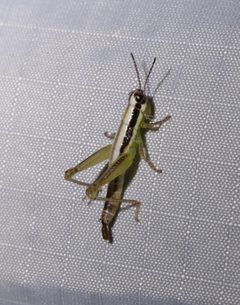
Gymnoscirtetes is a of small (11–22 mm), slender, flightless grasshoppers to the southeastern North American Coastal Plain. The genus was revised from two to six based on male genital and geographic data. Species are divided into two groups: the western morsei group (G. morsei, G. rex) and the eastern pusillus group (G. pusillus, G. pageae, G. wadeorum, G. georgiaensis). The genus is characterized by wings, linear body shape, and brownish-green or bronze coloration with a black lateral stripe.
Pronunciation
How to pronounce Gymnoscirtetes: //ˈɡɪmnəsˌskɪr.tiːtiːz//
These audio files are automatically generated. While they are not always 100% accurate, they are a good starting point.
Identification
Distinguished from other Melanoplinae by the combination of small size, extremely reduced wings, slender linear body, and black lateral stripe. within the are separated by male genital —particularly and shape—and geographic distribution. The two species groups (morsei group vs. pusillus group) are separated by the Ocklochnee River in Florida.
Images
Habitat
Primarily associated with mesic grasslands including pitcher plant bogs, flatwoods, and edges of seasonal ponds. Specifically inhabits low, moist, open portions of flatwoods, particularly where such areas slope to and border bayheads, bogs, fens, hydric hammocks, swamps, or seasonal ponds. Less commonly found in other grassland types including grassy sandhills.
Distribution
to the southeastern portion of the North American Coastal Plain, ranging from eastern Georgia west to Mobile Bay, Alabama, and south to Lake Okeechobee, Florida. The morsei group occurs from Mobile Bay, Alabama to the Ocklochnee River, Florida (western distribution). The pusillus group occurs from the Ocklochnee River, Florida to east Georgia and south to Lake Okeechobee, Florida (eastern distribution).
Behavior
Flightless due to wings. Camouflaged among dense patches of grass or tall slender vegetation where gracile form and lateral striping provide effective concealment. Pairing in copula has been observed.
Ecological Role
Functionally herbivores in temperate grassland systems. As grasshoppers of a global biodiversity hotspot, contribute to the high biodiversity and of the region's imperiled grasslands.
Similar Taxa
- MelanoplusOther spur-throated grasshoppers in Melanoplinae; distinguished by Gymnoscirtetes' wings and more slender, linear body form
- Other Acrididae generaMost grasshoppers in the region have fully developed wings and can fly; Gymnoscirtetes is immediately recognizable by its extreme brachyptery
More Details
Taxonomic revision
The was revised in 2022 (ZooKeys 1134) from two (G. pusillus, G. morsei) to six species, with the description of four new species: G. georgiaensis, G. pageae, G. rex, and G. wadeorum.
Conservation significance
The is to the North American Coastal Plain, a global biodiversity hotspot with highly imperiled grassland .