
Leptysminae
Brunner von Wattenwyl, 1893
spur-throat toothpick grasshoppers
Genus Guides
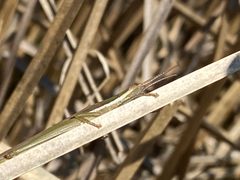
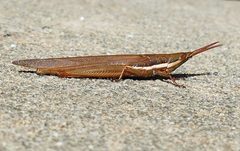
2Leptysminae is a of grasshoppers in the Acrididae, commonly known as spur-throat toothpick grasshoppers. The subfamily contains at least 20 distributed across North, Central, and South America. Members are characterized by slender, elongate bodies and association with aquatic or semi-aquatic . The genus Cornops, a well-studied member, has been investigated for of water hyacinth.

Pronunciation
How to pronounce Leptysminae: //lɛpˈtɪsmɪniː//
These audio files are automatically generated. While they are not always 100% accurate, they are a good starting point.
Identification
Distinguished from other Acrididae by the combination of slender, elongate body form and the presence of a spur on the throat ( surface of the ). The 'toothpick grasshoppers' refers to their notably slender build. Members of the Cornops can be recognized by their semi-aquatic association and morphological adaptations to aquatic environments.
Images
Habitat
Semi-aquatic and riparian ; associated with aquatic macrophytes in seasonally flooded wetlands, lakes, and river margins. The Cornops is specifically associated with water hyacinth (Eichhornia spp.) and pickerelweed (Pontederia spp.) in Neotropical wetlands.
Distribution
North America, Central America, and South America; ranging from the southeastern United States through Mexico and Central America to Argentina.
Seasonality
Activity patterns vary by and geographic location; Cornops aquaticum shows continuous presence with nymphs and collected across all seasonal periods (flood, high water, low water, dry) in the Pantanal, with highest morphometric values during flood periods.
Host Associations
- Eichhornia crassipes - plantwater hyacinth; primary for Cornops aquaticum
- Eichhornia azurea - plantrooted water hyacinth; for Cornops aquaticum
- Pontederia cordata - plantpickerelweed; for Cornops aquaticum
- Pontederia lanceolata - plant for Cornops aquaticum
- Pontederia subovata - plant for Cornops aquaticum
- Pontederia parviflora - plant for Cornops aquaticum
Life Cycle
Variable reported across the wide geographic distribution; differing numbers of instars and alterations to voltinism observed in different . In the Pantanal, both nymphs and occur year-round with continuous recruitment.
Behavior
in body size and morphometric measurements observed in . Phenotypic plasticity in body size influenced by geographic location and plant association.
Ecological Role
Herbivores specializing on aquatic macrophytes; Cornops have been evaluated as candidate agents for water hyacinth (Eichhornia crassipes), with specificity studies conducted to assess potential for .
Human Relevance
Investigated for of water hyacinth, one of the world's most problematic aquatic weeds. specificity and feeding preference studies have been conducted to evaluate safety for non-target plants.
Similar Taxa
- ProscopiidaeBoth have slender, elongate, stick-like body forms; (jumping sticks) belong to superfamily rather than , and lack the spur-throat characteristic of Leptysminae
- other Acrididae subfamiliesLeptysminae distinguished by semi-aquatic association, slender 'toothpick' , and spur on the throat; most other acridids are terrestrial with more robust body forms
More Details
Taxonomic note
Wikipedia and iNaturalist give conflicting counts (at least 2 vs. at least 20 genera); the Catalogue of Life and primary literature support at least 20 genera including Cornops, Cylindrotettix, and Leptysma.
Cytogenetics
Karyotypic studies have examined constitutive heterochromatin and nucleolar organizer region (NOR) distribution in five Leptysminae , revealing chromosomal characteristics useful for systematic studies within the .
Sources and further reading
- BugGuide
- Wikipedia
- iNaturalist taxon
- NCBI Taxonomy
- Catalogue of Life
- Super Crop Challenge #12 | Beetles In The Bush
- Morphometry of Cornops aquaticum(Orthoptera: Acrididae: Leptysminae) in the Pantanal of Mato Grosso, Brazil
- Distribution ofCornopsgrasshoppers (Leptysminae: Acrididae: Orthoptera) in Latin America and the Caribbean Islands
- Karyotypic analysis, constitutive heterochromatin and NOR distribution in five grasshopper species of the subfamily Leptysminae (Acrididae)