
Stenacris
Walker, 1870
spur-throat toothpick grasshoppers
Species Guides
1- Stenacris vitreipennis(Glassy-winged Toothpick Grasshopper)
Stenacris is a of spur-throat toothpick grasshoppers in the Acrididae, established by Walker in 1870. The genus comprises approximately six described distributed primarily in the Neotropical region and parts of the southeastern United States. Members are characterized by their slender, elongate body form typical of toothpick grasshoppers. The genus is classified within the Leptysminae and tribe Leptysmini.

Pronunciation
How to pronounce Stenacris: //ˈstɛnəkrɪs//
These audio files are automatically generated. While they are not always 100% accurate, they are a good starting point.
Identification
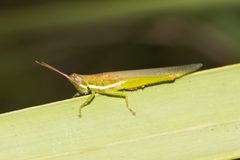
Toothpick grasshoppers in this can be distinguished from other Acrididae by their extremely slender, elongate body and long, thin legs. The 'spur-throat' refers to a diagnostic projection on the between the forelegs, a trait shared with related Leptysminae. Stenacris are generally smaller and more gracile than typical grasshoppers, with narrow wings that may be transparent or glassy in appearance (as in S. vitreipennis).
Images
Distribution
Neotropical region and southeastern United States. Documented occurrences include Argentina (northeast), Bolivia, Brazil (west-central and northeast), and Alabama (USA).
Similar Taxa
- LeptysmaAlso in tribe Leptysmini with similar slender body form; distinguished by differences in prosternal spine structure and male genitalia
- CoryphacrisAnother leptysmine with toothpick ; differs in wing venation and pronotal shape
More Details
Etymology
The name Stenacris derives from Greek 'stenos' (narrow) and 'acris' (), referring to the slender body form characteristic of the group.
Species diversity
Six are currently recognized: S. caribea, S. fissicauda, S. megacephala, S. minor, S. vitreipennis (glassy-winged toothpick ), and S. xanthochlora.