
Cibolacris samalayucae
Tinkham, 1961
Samalayuca Dune Grasshopper
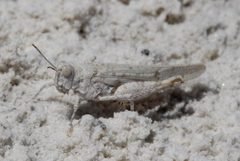
Cibolacris samalayucae is a of slant-faced grasshopper in the Acrididae. It is to dune systems, with its name derived from Samalayuca, a dune field in northern Mexico. The species occurs in Mexico, with records extending into the southwestern United States. As a member of the tribe Cibolacrini, it is closely related to Cibolacris parviceps, with which it shares morphological adaptations for life in sandy environments.
Pronunciation
How to pronounce Cibolacris samalayucae: /ˈkiboʊləkrɪs sæmələˈjuːkeɪ/
These audio files are automatically generated. While they are not always 100% accurate, they are a good starting point.
Identification
The Cibolacris is distinguished by a that appears disproportionately small relative to the body, with weak or absent and lateral carinae on the pronotum. Within the genus, C. samalayucae can be separated from C. parviceps by geographic distribution and subtle differences in pronotal structure. The tegmina are well-developed and extend beyond the .
Images
Habitat
Sandy dune systems, particularly the Samalayuca Dune Field and similar aeolian sand in northern Mexico and adjacent regions.
Distribution
Northern Mexico (Chihuahua), specifically the Samalayuca Dune Field region; possibly extending into adjacent areas of the southwestern United States (New Mexico, Texas). Distribution records indicate presence in Middle America and North America.
Similar Taxa
- Cibolacris parvicepsCongeneric sharing small and weak pronotal carinae; distinguished by distribution (C. parviceps occurs in Colorado and adjacent states) and subtle structural differences in pronotum and tegmina.